Physical activity after a stroke

Physical activity levels in people that experienced a stroke do not meet general activity guidelines.

After 20 years in practice, I’ve evaluated and treated many patients with a stroke. On the flip side, I have family that have experienced a stroke. I’ve learned that each person is unique. Each person has a unique personality and drive. Each person has a different “why”.

When I say “why”, I mean “why” try to get better”? “Why” go through therapy? “Why not” just sit around and get busy dying.

My uncle had a stroke. He was a pillar of health before the stroke. He was a gettr done guy. Why wait for someone to do that which I could do. I have major respect for my uncle because his life and my dad’s parallel each other.

With that said, after his stroke, is still determined to be independent and is back to living his best life. He has physical limitations, but he worked hard to figure out how to get around those limitations. He is back to volunteering and helping other veterans like himself.

On the flip side, I have seen those patients that fall into the “why…me” track. These patients struggle to get better.

My first patient as a student intern was in a subacute rehab. I was given the choice of two patients. I could’ve treated the patient that just had a total knee replacement (back when I first started in this profession, patients stayed in the hospital for days and then went to a skilled nursing facility or subacute rehab commonly after the surgery). Instead, I chose to take the patient that experienced a stroke. I knew in my career that I would see thousands of patients with knee replacements, but I wouldn’t be in the setting to see as many patients that experienced strokes.

I remember this patient vividly. He was a business owner and he had a name and business that used alliteration in his introduction. Once he introduced himself, the glitter in his eye disappeared. He started crying almost immediately.

THIS WAS MY FIRST PATIENT AS A STUDENT!

WTF!

I had a lot of experience working with people that had struggles, having grown up either at a private bar or local VFW.

This guy was told by his doctors that he would never walk again (doctors are not God). If you’re a physician reading this…be careful how you speak to patients. This also applies to physical therapist that are reading the blog.

The patient went on to tell me how he lost his business, his wife divorced him and took everything he had but the crucifix on his neck. His van broke down and he would have to live in his van (not down by a river for those old enough to get it).

Also, for my first day at the rehab unit, my clinical supervisor told me that she just got a promotion and wouldn’t be able to be with me at all during my internship and that she was sure I’d do well.

That sucked and added a little more pressure to my clinical. I almost got kicked out of this clinical twice, which is better than the time that I do get kicked out of an inservice later in my student career.

Back to the alliteration introduction patient.

He was crying, sitting in a wheelchair, and feeling horrible for himself because of what he was told by God…I mean the doctor.

I had a choice to make. We always have a choice to make when working with people. Which version of me dos the person in front of me need at that specific point in time.

I flipped the coin between empathetic shoulder to cry on and ear to listen and “eat lightening and crap thunder” (this is Mick from Rocky for those young whippersnappers).

I chose Mick. I was as hard as I could be without being an asshole (which was good that I didn’t have a supervisor because she may have thought I crossed the line on day one when I said “you want to cry or you want to walk!“).

This guy chose to walk. By the time he was discharged after 4 weeks, I took him for a walk around the outside of the hospital grounds. Realistically, I sat in the wheelchair and he pushed me for about 15 minutes.

This guy not only walked, but he regained his freedom in life. He changed his perspective. He didn’t have to live by a river, but was able to get a job and get back on his feet.

I’ll never forget alliteration introduction guy. He got that sparkle back in his eye by the time he was discharged.

THE PATIENT IS THE ONLY PERSON THAT MATTERS!

Not the stroke! The patient may always have disabilities, a limp, an inability to walk, but it’s sour job to help them find the “why”!

That “why” is what will help the patient to increase physical activity levels. We may not “fix” the problems, but we need to do our best to not let problems compound on problems.

How one book can change your pain.

Neck pain affects many, and treatments like spinal manipulation therapy, medication, and exercise can help.

A majority of the population will experience neck pain at some point in life.

Treatments commonly used for neck pain are spinal manipulation therapy, medication and a home exercise program.

Bronfort et al (2012) tried to answer the question regarding which option may be the best treatment for neck pain.

The manipulation group received mobilization and manipulation of the cervical or thoracic spine after an evaluation in order to determine if there were any areas of the spine that did not move well. These patients were assessed by chiropractors with at least 5 years of experience. The chiropractors could use any technique and see the patient for over a 12 week period. The patients in the spinal manipulation group could also receive light massage, assisted stretching, and hot/cold packs. The visits lasted 15-20 minutes.

The medication group received NSAIDs, acetaminophen, narcotics, and muscle relaxants. The visits lasted 15-20 minutes and the patient was seen based on a physicians recommendations.

The home exercise group received 2 sessions lasting an hour per session split over the course of 1-2 weeks. These patients were issued “Treat Your Own Neck” by Robin McKenzie. These patient’s sessions also discussed basic anatomy and advice regarding posture, lifting, pushing and pulling.

How’s this sound thus far? We all have our biases. Aside from medication management, as a PT, I am trained on both Spinal Manipulation Therapy and Mechanical Diagnosis and Therapy, which is the basis for the book used in the study.

Having treated patients for 20 years has allowed for perspective. My bias is that the exercises will have a greater effect than the manipulations, but I also believe that manipulations have value for patients. The thought is that if we spend our time with patients only doing hands on activities such as massage and manipulations, that we will never “ teach a patient to fish”. The patient will always be depending on the “hand out” or better described as the “hands on” from the therapist. In reality, spinal manipulation therapy and exercises are meant to be used as an adjunct to get the patient back to life and no longer need to grab their wallet to pay for healthcare services.

In the end, both spinal manipulation resulted in similar outcomes for patients except for one category in which spinal manipulation will typically be favored as explained above…patient satisfaction.

In my humble opinion, people like when things are done to them or for them instead of having to do the work themselves…especially when they are paying for it! This holds true for going out to dinner, oil changes, home repairs etc. There will always be a service sector making money by minimizing the work needed by the customer.

One result that favored the exercise group was neck range of motion.

The exercise group and manipulation group scored similar on their perception of function, but the exercise group moved more.

Let’s put this in perspective:

The manipulation group used 15 vists on average

The home exercise program used 2 visits on average

The medication group used 5 visits on average

Time is money. Would you rather pay for 15 visits to get similar functional results, but less range of motion if it saves you the effort of doing exercise yourself or would you rather save the time and money but put the effort in yourself?

The good news is that you have options and both lead to similar results.

If you have a high deductible, you may prefer to pay out of pocket for 2 visits instead of 15.

If you have met your out of pocket max, you may just see it as free healthcare and want to go for the hands on experience.

All of this is important and your physical therapist or chiropractor should be having this discussion with you at some point t in your care.

If you are in need of physical therapy in the South Chicago Suburbs, I’m here to help. I’m trained in both spinal manipulation therapy and the “McKenzie Method” and finally am a Board Certified Physical Therapist in Orthopedics through the American Physical Therapy Association.

If you are interested in the book that resulted in 2 visits, click the link below

https://amzn.to/3OYV7cN

Basics of health insurance

The Costco #costcoconnection actually has some pretty good articles.

This is a topic that unfortunately many don’t understand or take the time to understand how it impacts them during the year.

When I was in private practice, I had so many conversations with patients and prospective patients about deductibles, copay, co-insurance, and especially towards the end of the year…out of pocket max

Ok.

  1. Deductible: most all insurances now have a deductible. This means: the amount of money that the patient has to pay(after adjustments) before the insurance company will start paying their part.
    Check out the funny video in the comments to learn more about adjustments.

If a patient has a $5000 deductible, it means that the patient is paying all of the medical bills in whole for the first $5000 before the insurance company kicks in.

Why does this matter?

If you have a high deductible and don’t plan on spending more than $5000 in a year, it may be better to go through a cash based medical practitioner instead of using insurance.

The cash based professional may actually be cheaper when averaged over the course of a year, even though you still are paying the premium (the amount you pay out of your paycheck every 2 weeks etc) to carry the insurance to cover the risk of major medical issues.

If you know that you are a frequent flyer of the medical system, then purchasing a lower deductible may be more advantageous than the high deductible plan.

This takes some analysis and guess work every year to determine which plan one will buy into.

  1. Copay/co-insurance: after you paid your deductible, the insurance company will now start to pay for some or all of your medical care after this point, depending on what your insurance is contracted to pay. It’s common to see insurances pay for 80% of the ADJUSTED BILL, and the patient is responsible for the other 20%.

This means that you first pay for your premium (the amount coming out of your check to have the right to carry insurance, the n You pay your deductible: the amount of money you have to pay out of pocket before you trigger the insurance paying for anything to begin with AND THEN YOU PAY THE COPAY OR CO-INDIRANCE: which is the part you agreed to share of the payment with your insurance company of your medical bills.

  1. Out of pocket max: this is like the heavens have opened (depending on the perspective). This means that you have spent so much on your own healthcare throughout the year that the insurance company now says: you’ve been tortured enough, we’ll cover everything from here.

This means that the insurance company will now start paying for everything (heavens opening up and angels singing), BUT it also means that you were so sick and needed so many procedures and testing throughout the year that you spent through your premium, deductible, and copays/co-insurance.

Nose to wall touch

This was one of the exercises written about in a protocol post Achilles rupture. I had to call the surgeon to understand what this actually meant. Once I was educated on the exercise, I figured I’d pass it on, since I thought myself to be well versed in exercise but had never heard of this particular movement.

My journey is not your journey

“don’t you dare compare your beginning with someone else’s middle“

I can see how this happens frequently, even in my own profession as a PT.

I hear it from new graduates, “we can’t all know as much research as you do.”

I hear that and I get pissed.

I wasn’t born with research inputted into my brain.

I wasn’t spoon fed the research through lectures.

I spent hours per week reading.

When I hear others tell me that they can’t do it…I think that you have other priorities. That’s fine, but don’t attempt to demean my priorities. Don’t try to knock me down so that you feel better about yourself, because I won’t have it.

My need to become better at my profession was a stronger force than most other priorities in my life, at the time.

Needless to say, my priorities weren’t well organized for the person I am today.

The issue that I see is that I looked at others in managerial positions and thought, I could do that.

I looked at people that were owning businesses and thought, “I could do that”.

I don’t want to do that.

I don’t want to be tied to my profession with the same short leash that I had my first 5-8 years.

I want more freedom to spend time with the kids (in small doses of course).

I want more freedom to be able to watch 3-4 hours of wrestling per week (don’t judge, we all have our indulgences that we would rather not do away with).

Now, I only have to do what I need to do to take care of my family and what I want to do to be happy. It took decades to grow into this person.

Don’t compare your journey to mine and I won’t compare my journey to others.

Work/time = something

“ I mean that you focus in on the dream you have, you do the work, you put in the hours, and you stop feeling guilty about it!“

I quit the hospital the second time to move to Virginia. It was a great time! It lasted a whole weekend (seriously my address was Fairfax, Virginia for a whole two days). I quit the hospital on a Thursday. I was back on a train to Chicago and then the Rock Island to Mokena by Sunday.

Needless to say, I called FW at Palos Hospital and was back to work at the hospital the next week. Although it seemed like a short vacation that I was away from the hospital, because I put in my notice, I lost all of my seniority, which included vacation time. Not a huge deal though because they hired me at the hourly rate i was receiving when I quit. I got a 90 day raise after my probationary period ended.

Another small detail is that I returned home having filed for divorce.

This whole story was to tell one small detail. I actually obtained a job in Virginia, one in which I never started but did the interviews. Virginia was, at the time, a direct access state for anyone that had a DPT. Without a DPT (doctorate degree in physical therapy) a PT could not see a patient “off the street” unless he/she took a differential diagnosis course.

I realized that the DPT has a little value. At that point I decided that I was going to obtain a DPT degree. (In hindsight, I could’ve just as easily taken the differential diagnosis course, but having moved back to IL without any furniture or television set, I had nothing better to do with my time. Literally, I thought to myself…I got some time to kill and the hospital agreed to pay $3,000 per year…I might as go get a Doctorate degree). The coursework for the DPT was relatively easy, but time consuming. I am proud that I did this and obtained the DPT. Not because of the title, but because now I can argue both ends of the argument regarding the DPTs worth; it only cost me $5K over three years.

In the end, I keep it simple.

“Just keep swimming. Just keep swimming”

Taking a jump

“ in fact, when you understand that you don’t have to justify your dreams to anyone else for any reason, that’s the day you truly begin to step into what you’re meant to be.“

I’m going to agree to disagree on this one. As you heard before, I made quick changes in my career without consulting my then wife…that relationship ended.

Although I don’t have to justify my dreams, I have to justify my decisions to my family. Making a quick jump, or even a well-thought-out jump, to satisfy my dream may not be worth it if the dream adversely affects family finance or security.

For instance, I quit the hospital the third time (that’s right, they took me back a second and third time) in order to chase a dream of managing my own clinic. I took a stupid pay cut in order to do this. I chose to cut my own pay by almost 20%. Not only that, I quit the cushy hospital job to go manage a clinic that was easily losing $100K per year. After 6 months of following my dream…reality set in. My wife said that I had to make a decision of opening my own clinic and leaving this one or going to find a job.

That was a smart move on her part. Although I increased the number of patients that were coming into the clinic by a little over 10%, it still wasn’t enough to justify the overhead that I inherited and the salary that I was getting. I was averaging about 28 visits per week, but that amount of money barely covered the overhead. There was no chance of profiting any time soon. Because of that, there was no chance of getting a raise any time soon. Mind you, during this time period I was also ranked in an honorable

https://www.google.com/amp/s/www.updocmedia.com/2017-top-40-influencers/amp/

Class by my peers. This was my opportunity to advance my lot in life. I am now making about 10% more than when I left the hospital and this year will mark my break even point. Every week after this year marks a betterment than where I was when working for the hospital. The cool thing is that I am still following my initial dream because I now have my own company, am managing patients the way I feel appropriate, and have created close relationships with many physicians and the community I serve. This was what I set out to do when I initially left the hospital.

Don’t get me wrong, Palos Hospital was a great place to work. I worked with an unbelievable team in which we all respected each other’s strengths and there were no egos on the team. (I say that because I may have had the biggest ego at the time so no one else appeared to have an ego in comparison.) None of us would hesitate to reach out to another PT or PTA if we were stuck with a patient. I have always recommended anyone to take a job there if they have the opportunity. My chief complaint with the hospital was that there was no chance of advancing one’s career, and I was looking for more.

If I never took that chance to chase a dream, I would still be in a job that I was frustrated with, although more changes were made after I left which may have satisfied my need for change. If my wife didn’t have that conversation about the reality of finances, I may still be trying to steer a sinking ship that I inevitably had no control over.

I now am in a spot to have more control and am avale to support my family while advancing my career, community involvement, and education of peers.

Patients pay for services

Anyone that says that people won’t part with money are delusional. We know that people are paying cash for PT services. We know that people are meeting their deductibles and paying copays/coinsurance.

As professionals, we have to figure out how to educate patients on

1. Solving their problems

2. Understanding the true costs of healthcare.

Patients first purchase our services because of a few reasons

1. They were referred to us by their physician.

2. They are referred to us by their friends/family

3. They hear about us from internet searches

4. They choose us blindly

Regardless of how they find us, we have to give them value when they come to us.

For instance, my mom had therapy at one of the big chains a few years back. She said that she would only be able to attend PT twice per week, but the PT has her sign up for 3x/week. What do you think happened?

She canceled her appointment once per week…because that’s exactly what she said that she would do when asked about frequency.

Instead of listening to the patient and scheduling 2x/week, they scheduled 3x/week and after 3 weeks they discharged her for non-compliance.

Who was in the wrong? Was the clinic providing value…maybe? Did they listen to the patient and establish expectations and alliance…nope.

The value of the session always lies with the receiver and not the giver.

Many of us tho I ourselves to be rockstars…me included, but take this piece of advice from “The Rock“.

What matters is what the patients think and how they perceive the service. They are the ones paying for the service. We have to establish the expectation with the patient and then…deliver.

They will part with their money in these situations. We just have to follow the basics.

Cualquiera que diga que la gente no se separará del dinero es delirante. Sabemos que las personas están pagando en efectivo por los servicios de PT. Sabemos que las personas alcanzan sus deducibles y pagan copagos / coseguros.

Como profesionales, tenemos que descubrir cómo educar a los pacientes sobre

1. Resolviendo sus problemas

2. Comprender los verdaderos costos de la atención médica.

Los pacientes primero compran nuestros servicios por algunas razones

1. Nos los remitió su médico.

2. Son referidos a nosotros por sus amigos / familiares

3. Se enteran de nosotros por búsquedas en internet

4. Nos eligen ciegamente

Independientemente de cómo nos encuentren, tenemos que darles valor cuando vengan a nosotros.

Por ejemplo, mi madre recibió terapia en una de las grandes cadenas hace unos años. Ella dijo que solo podría asistir al PT dos veces por semana, pero el PT tiene su inscripción por 3 veces por semana. ¿Qué crees que pasó?

Ella canceló su cita una vez por semana … porque eso es exactamente lo que dijo que haría cuando se le preguntara sobre la frecuencia.

En lugar de escuchar a la paciente y programar 2 veces por semana, programaron 3 veces por semana y después de 3 semanas la dieron de alta por incumplimiento.

¿Quién estaba equivocado? ¿La clínica estaba aportando valor … tal vez? ¿Escucharon al paciente y establecieron expectativas y alianza … no?

El valor de la sesión siempre recae en el receptor y no en el donante.

Muchos de nosotros pensamos que somos estrellas de rock … yo incluido, pero tomo este consejo de “The Rock”.

Lo que importa es lo que piensan los pacientes y cómo perciben el servicio. Ellos son los que pagan por el servicio. Tenemos que establecer la expectativa con el paciente y luego … entregar.

Se separarán con su dinero en estas situaciones. Solo tenemos que seguir lo básico.

PT in the pandemic

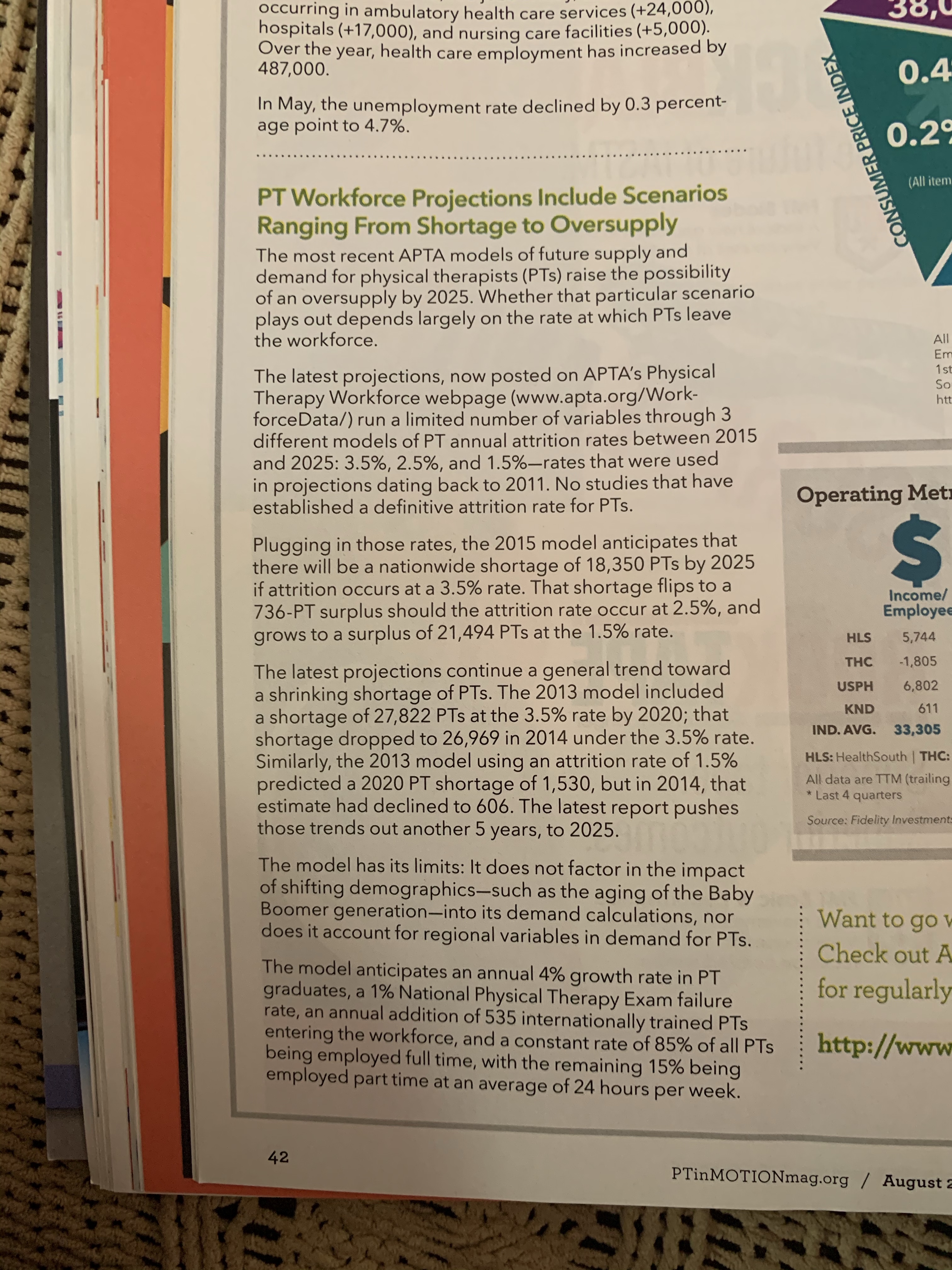
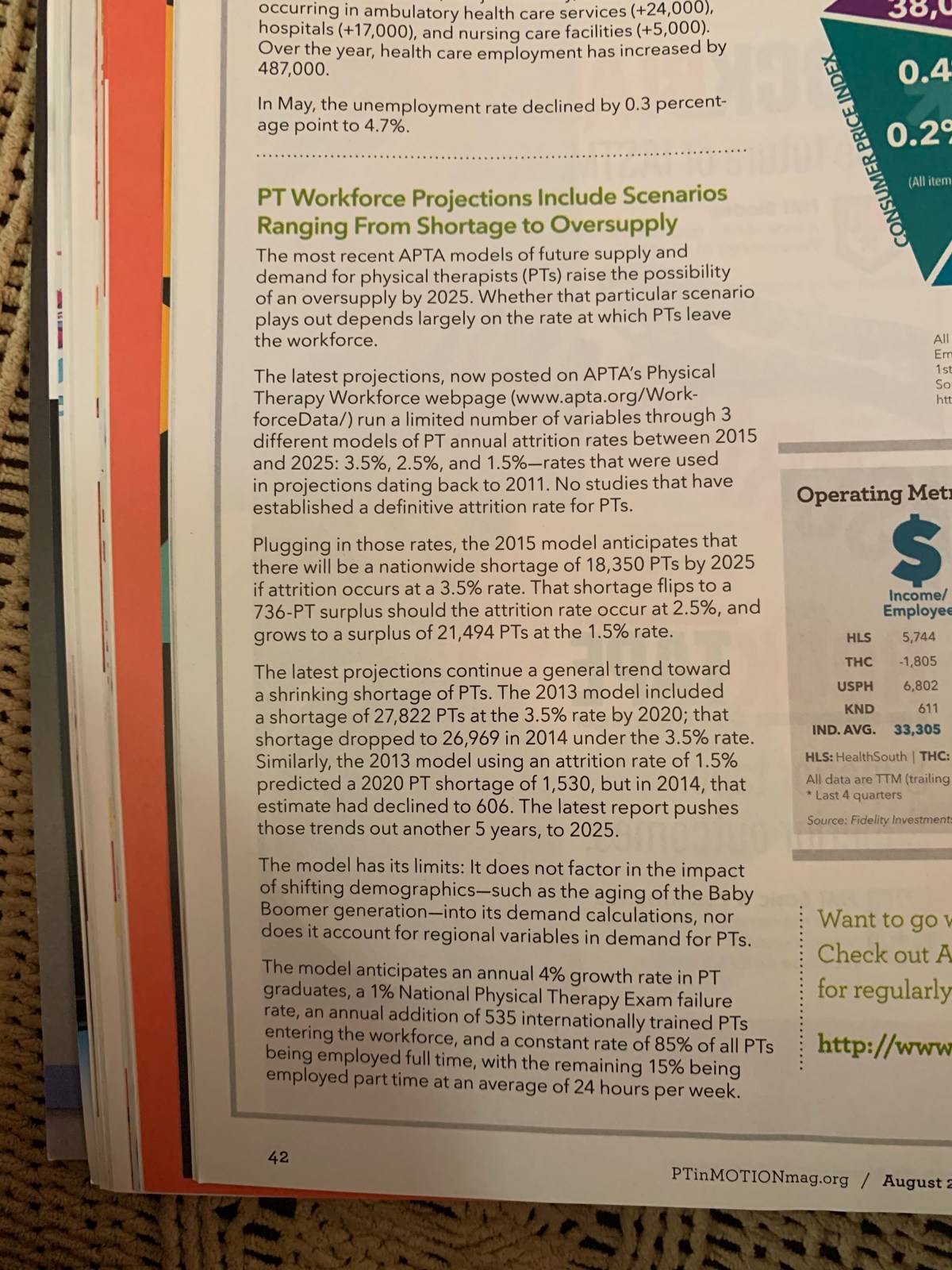
The physical therapy profession is frequently ranked in the top xyz jobs in the country. Looking at the statistics above, we are seeing that the field may reach saturation in my lifetime.

The previous data doesn’t take into account new school openings, which in my state is projected to graduate an additional 120 PTs per year. This doesn’t take into account the 210+ PTs that already graduate in the set of IL per year.

I write this during the COVID pandemic, which sees many PTs out of work, furloughed or laid off. I can remember during the housing crises of 2008, I thought that I was in a recession-proof job. We are seeing now that this is not the case. I thought that even in the worst times that I would be able to keep my salary steady and have increased buying power during these down times…I was wrong.

There are only certain jobs, in our profession, that are safe during the pandemic. Outpatient physical therapy is not among those types of jobs.

This pandemic will change much in our profession. We are seeing the rapid growth of telehealth. We are seeing more patients agree to in-home PT. We are seeing “mill PT clinics” transition to one-one care because of safety concerns regarding seeing more than 1 patient at a time.

There are many opportunities for PTs that are not afraid of work. There are many challenges for those that haven’t accepted the fact that this profession has to be more than the 9-5.

How will you change your outlook for the career due to the pandemic?

What do you think will happen to our profession in the future because of the pandemic?

Finally, how are you improving your skills to make yourself more recession-proof in the future?

modified STarT Back Tool

“For example, individuals at a low risk of persistent disabled problems can be reassured and discouraged from receiving unnecessary treatments and investigations, while those at high risk can matched to treatment which combines physical and psychological approaches”

For those of you that haven’t read my previous posts on the Start Back Screening Tool, then this first post may not make sense. It is recommended to read those posts before reading this post.

In short, some patients improve without treatment, with simple advice to stay active.

“In addition, an implementation study testing risk stratification for patients with low back pain in routine general practice demonstrated significant improvements in physical function and time off work, sickness certification rates and reductions in healthcare costs compared to usual non-stratified care.”

Who knew? 🤷‍♂️

If we start classifying patients, we tend to get better results.

This should be a no-brained. Two different patients with similar pains may respond completely different to treatments. We need to be able to determine which type of intervention/or lack of intervention is best paired with each type of patient.

Until we get better at understanding the patient and both the patient’s response to movement and belief systems, we will continue to fail a percentage of these patients when they come into the clinic. Some patients will improve regardless of the intervention/treatment.

“GPs are not alone in wanting information about patients’ likely prognosis over time, as >80% of musculoskeletal patients also want prognostic information from their GO, although less than a third actually receive this information”

The fact that almost 1/3 of patients receive information from their physician is surprising to me. With shortened face time with physicians and the incentive to refer within the system in which the GPs operate, I’m surprised that there is enough time to spend educating even 1/3 of patients.

We know that patients want information. What is bothersome to me is that some practitioners, throughout healthcare as a whole, give patients flippant answers without substance. These patients then hang on to that information and allow it to dictate how they live or avoid living life.

To tell a patient with osteoporosis that they will fracture their spine when flexing can produce fear of a movement and greatly impact the patients quality of life. Giving the patient statistics about fracturing, not just with bending but also with staying neutral, allows the patient to have a more active role in decision-making.

The last thing we want to do is to label a patient, or cause a patient to label themself, as having “big bones”, slipped discs, degenerative spines, or as many of my patients say “Uncle Arthur”.

“The distribution of primary pain regions was reported by clinicians as: lower limb 31.1%, Back 28.7%, upper limb 23.5%, neck 11.8%, and multisite pain 4.8%”

The modified STarT Back tool is a version explores more options than back pain only.

“…a modified STarT Back Tool is similarly predictive of 6-month physical health across different musculoskeletal pain regions.”

This type of prognostic data is important for healthcare providers to obtain in order to build a long-term plan for patients beyond simply 3 times per week for 6 weeks of therapy.

What happens to patients after this six weeks?

If we have not educated and empowered the patient, they will become a patient again.

“This implies that the existing STarT Back Tool score cut-point (4 or more out of 9) used to allocate patients with low back pain to the medium-risk/high-risk subgroups cannot simply became applied to patients with other musculoskeletal pain presentations or in different clinical services”

This is pretty self-explanatory. We can’t use a back tool to help us make decisions about a knee pain, neck pain, headache, etc.

“It is found that regardless of body region of pain, higher modified STarT Back Tool scores were associated with higher levels of kinesiophobia, catastrophising, fear avoidance, anxiety and depressive symptoms.”

Kinesiophobia is fear of movement. Catastrophising is making a bigger deal out of a situation than it actually is. Fear avoidance is actively avoiding an activity for fear of making oneself worse.

None of these descriptors are good, but you know what…we work with them in physical therapy.

Let me say this differently…a good physical therapist will work on these issues, but not all address these issues.

For more information on projects that I am working on, please visit my podcast

Article