

Comparing McKenzie to a cognitive behavioral treatment strategy

Got back pain?


This is a study that compares two different treatment approaches head to head. Bout damn time that we are looking at two approaches and comparing them in a study. We (health care researchers) typically compare one treatment against no treatment. This is good and all, but then we believe that all treatments work and work equally. These are the types of studies that need to come out, so that as a health care provider, I am providing the best treatment to help your problem.


  1. “A recent UK survey estimated the (1-month period) prevalence of spinal pain to be 29%”


This means that during any one month period about 1 in 3.5 people are experiencing back pain, over on the other side of the pond. Think about that! If you have one person on each side of you, one of you will have back pain during the month.


  1. “The lifetime prevalence of these conditions is also high—it is estimated that »70-85% of the population will experience some spinal pain during their lifetime”


Again, 8 out of 10 people will have back pain during their lifetime. This is starting to sound grim. Pain is not normal. What are we doing to ourselves? Why do we keep having back pain at such an alarming rate? I have my opinions, based on some research, but it hasn’t been fully substantiated yet. I will pull out the research at a later date of course.


  1. “In 1998, the cost of lower back pain alone to the UK National Health Service was estimated at 1 billion (pounds), with over 200 million (pounds) being spent on physiotherapy”


So…what’s this got to do with us? That’s the UK. The numbers aren’t too far off of what we are spending on back pain. See the link from a previous post in which I discuss monetary figures.

https://movementthinker.org/2016/03/17/a-little-bit-of-crazy/


  1. “guidelines state that in the first instance patients should be encouraged to remain active, with the prescription of anti-inflammatory drug and/or analgesia where required.”


There is an opiod epidemic spreading world wide. I realize that opiods and anti-inflammatories are a long ways away from each other, but to think that back pain will be fixed with medication only is dreaming. NSAID’s are not always the answer either. http://www.aafp.org/afp/2002/0401/p1319.html


Robin Mckenzie states in his textbook (paraphrased): a mechanical problem needs a mechanical answer and a chemical problem needs a chemical solution. The first question has to be: is the pain mechanical or chemical?


To remain active is the same advice that I could get from my dad. You’ve heard the advice countless times I’m sure…especially if you’ve ever been hit by the ball while standing in the batter’s box…”walk it off”. Hell, my dad was a laborer. He didn’t go to medical school, but gives the same advice. I pay for better than that. I can get the advice for free back in Elwood.


  1. “Physiotherapy treatments aimed at alleviating the physical causes of back and neck pain include: advice, exercise programmes, massage, mobilization and manipulation”


Some big takeaways from this sentence are what was left out of the sentence. At no point did the authors talk about ULTRASOUND!, ELECTRICAL STIMULATION!, TRACTION!, VAX-D (sp)! CUPPING! or any of the other passive fads that make clinics money for doing thoughtless work. Look…if the above (in capital letters) makes up a part of your treatment, you have to question your practitioner as to why and what are the expectations of the intervention. I know what my expectations are…lining the owners pocket with greenbacks.


  1. “a new type of intervention for treating back and neck pain has recently been developed, triggered by growing awareness that psychosocial factors play an important role in musculoskeletal complaints. These behavioural interventions have different compositions depending on the specific theory underpinning the approach.”


To think that the “biopsychosocial” approach is new is a fallacy. It is a newer concept to put a name to it, but even those that simply have “mechanical” training understand that in order to use “mechanical” training, we have to get through the psychosocial constructs of each patient.


  1. “elucidating whether a treatment offers good value for money in terms of cost vs benefit must also be considered”


This is an interesting topic that is finally coming to the forefront in healthcare. I’m going to go to the extremes to make a point. Let’s say that you have a heart problem and a surgery that costs 100,000$ will keep you alive for decades, but a surgery that only costs $1,000 can keep you alive for a year. Which would you take? Costs vs benefits become very apparent in this scenario. This article will scale the topic down to back pain.


  1. “The trial compared two physiotherapists delivered interventions for musculoskeletal back and neck pain, which aimed to promote return to normal activities…Solution Finding Approach, was a brief physiotherapy intervention based on cognitive behavioral principles…a patient-centred view and, in this context, aims to help patients identify reasons for their pain and to provide solutions and long-term management strategies”


This essentially says: this approach consists of few physical therapy visits in order to help you figure out why you have pain and to provide solutions to long term management of your pain.


Remember this because it is important for the next section.


  1. “The second approach was the more traditional biomechanical approach used by physiotherapists, the McKenzie approach, which involves classification of patient’s spinal condition and the prescription of specific therapeutic exercises.”


This one states the following: The therapist will help you figure out why you have pain, through a classification system, and issue solutions (exercises) in order to provide long term management of your pain.


Sounds fishy…I don’t know if I like either method since they both sound so similar. Those that know me, know that I am biased. I am certified in the McKenzie method, formally known as Mechanical Diagnosis and Therapy.


  1. MeKenzie approach…has been clearly documented…commonly used by physiotherapists…conducted a biomechanical assessment using repeated movements of the spine and, based on these findings, prescribed specific exercises for the patients to work on repeatedly themselves…relies on active compliance with the exercises and advice.”


MDT (McKenzie method) was created a long time ago. I know the history like the back of my hand, but it seems like too much to type out here. Look up his biography, “Against the Tide” to read how this man revolutionized the way spines and now extremities are treated…by those that have studied the method. In a time in which not many believed him, and many went so far as to ridicule his methods, it took almost 50 years to confirm his thoughts through science.


Anyway, we use repeated, sustained, resisted and speed based positioning in order to elicit a change in symptoms. Manual techniques can also be used to elicit a change. Once we see a change that is documented with having good results…we stop there and send you home with the exercise, position or movement.


  1. “All the physiotherapists delivering the McKenzie approach were experienced in this method and had undertaken McKenzie Institute training (courses A-D).”


This is important. Scott Herbowy, one of the highly trained professors of the method, published a study in the recent years regarding the training and outcomes of those using the methods. It seems realistic to believe that someone that has taken courses A-D would have the same reliability and outcomes as someone that has taken the same courses and passed a competency exam. This is not true though. Those that have not yet passed the test appear to be inconsistent in classifying patients using MDt. See the study below to learn more:


http://www.ncbi.nlm.nih.gov/pubmed/24253786


  1. “…both the McKenize and Solution Finding approaches lead to improvements in patient outcomes over time, with no significant differences between the two treatments.”


Both treatment ideas provide similar improvements over time. This indicates that just in terms of improvements, it doesn’t matter which method is used (albeit neither group of therapists were highly trained in using the intervention attempting to be studies). I liken this to asking an auto mechanic to work on a Boing Jumbo Jet. Yes…the mechanic understands engines, but there’s a difference in specialties.


  1. “The McKenzie treatment required on average, one extra subsequent visit to the physiotherapist”


This means that seeing a therapist semi-trained in MDT will cost you an extra $100 dollars compared to seeing someone semi-trained in the Solution Finding Approach. Is this a bad thing? We will see.


  1. “the Solution Finding Approach is slightly cheaper than the McKenzie approach but confers marginally lower benefit”


Dave Ramsey has a free radio show about finances. One of his taglines is “the advice is worth what you pay for.” Obviously he’s kidding, but we all know that the better stuff in life isn’t free. When it comes to your health, how much more are you willing to pay? Are you willing to pay “slightly” more?


  1. “The policy maker needs to decide whether she or he is willing to invest additional health care resources funding the McKenzie approach”


Look, you need to find someone that has this certification or diploma training if you have back pain. Countries are debating whether or not more money should be put into training therapists in this method. Some of us have paid for the training out of pocket in order to become better therapists, with the end goal of providing great care to patients.


  1. “the additional cost associated with the McKenzie treatment is worth paying, given the additional benefit it provides”


NEED I EXPAND ON THIS SENTENCE? This benefit is from people that aren’t even “minimally competent” to provide this service. Imagine how much more benefit or less cost that you would have from someone that is competent in using the method.


This study was performed in the UK. There is no reason for me to believe that back pain differs that significantly from those experiencing back pain in the US. I have to correlate that those seeing a McKenzie Credentialled therapist will see even better results or spend less money over the long haul than that those seeing someone using cognitive behavioral therapy.


Quotes taken from: Manca A, Dumville JC, Torgerson DJ, Moffett JAK, et al. Randomized trial of two physiotherapy interventions for primary care back and neck pain patients: cost-effectiveness analysis. Rheumatology 2007;46:1495-1501.

MRI’s fact vs fiction


This was a great article. It puts numbers to the faces seen on MRI’s. I like numbers…kind of like Rainman. Numbers comfort me. Enjoy the read. There is some higher level thinking in the below quotes. If you have any questions, leave a post either here or on the movementthinker Facebook page.


  1. “Magnetic resonance imaging (MRI) provides clinicians with a noninvasive mechanism for viewing lumbar anatomy in great detail”


READ AND RE-READ THE ABOVE STATEMENT.

Question #1 from the above statement: Can an MRI tell me what is causing your pain?


Question #2: Can an MRI tell me how to treat you?


Question #3. Does the MRI differentiate between abnormal structures that cause pain and abnormal structures that don’t cause pain?


The answer to all of the above questions is NO! Everyone seems to think that they need an MRI before they come to therapy…as if I am going to just treat them on a whim without the MRI…or that the MRI will somehow give me a paint by number way of treating the symptoms. This does not exist. The MRI can be helpful in a small percentage of patients that are either seeking or needing surgery, but aside from that it is just something for me to read after I have performed my clinical assessment of the patient and come up with my own conclusion. Now…if my conclusion matches the MRI then awesome! Well…at least for me. If it doesn’t match the MRI…that sucks because now I have to go back and reassess to see which one of us is more right…the PT or the MRI.


  1. “For example, large variations in lumbar disc and radicular canal morphology have been identified in both symptomatic and asymptomatic individuals”


This means that an MRI is very good at determining what is not normal, as compared to a textbook, but the variations of normal is so wide that the test may not tell us much.


  1. “…challenge for examiners in their attempts to differentiate between observations that are “symptom generators” and those that are benign variations”.


When a radiologist reads your MRI, they are the ones that are determining what is going on in the pictures, they spend on average of 30 seconds per picture. In 30 seconds, they have to figure out what is abnormal. Then, if they have found something abnormal, they have to determine if it can cause your symptoms. All of this is performed without ever evaluating the most important aspect of the symptoms…YOU! The radiologist never sees you. If you look at the bottom of your report (assuming that you have already had an MRI), you will typically see the phrase “patient would benefit from clinical examination to correlate imaging”. This is the radiologist saying; “Look, I only have the pictures. I can tell you with a degree of certainty what the MRI says…does this fit your symptoms?”


  1. Patients were classified according to this table:


  1. Primay LBP (low back pain): pain in the back or buttock


  1. Posterior thigh referral: pain in one or both back/lateral thighs with or without LBP


  1. L1-L3 distribution: pain in the anterior thigh and top of foot


  1. L4-5 distribution: pain in the mid and distal anterior thigh, anterior leg and top of the foot.


  1. S1-S2 distribution: Pain in the lateral border of the foot and bottom of the foot


  1. Bilateral distribution: any combination of the above in both legs instead of one leg.


  1. Atypical: none of the above.


This is an overall pain pattern distribution. Unfortunately, this is not drilled in PT school. I was about 2-3 years out before I figured this out on my own and then after discovering it, I looked it up. It’s funny…if you don’t know what you don’t know, then you don’t know how to find it. I think that PT’s schools should heavily bias students in this direction for learning. Think of it. If you knew that for every dollar you invested, you would get an 80% return if you simply knew a few tricks…would you learn those tricks?


Roughly 80% of the population will have back pain at some point in his/her life. This is either the primary or secondary reason for physician office visits (depending on which research you read) and the one that it competes with is the common cold. Think about that…back pain is about as “common” as the cold.


  1. “All images were initially screened for evidence of neoplastic, inflammatory or infectious disorders…”


This is all of the very bad stuff that needs to be ruled out if someone is going to look at an MRI. This is stuff that won’t get better with therapy. If you have certain characteristics, your PT may refer you back to your physician in order to rule out the nasty stuff.


  1. “…study involved 408 participants…55% had acute pain…50 participants reported a recurrence of previous symptoms within the past 2 months…303 participants reported chronic symptoms of longer duration than 2 months”


This sounds about right. Those with back pain may have it go away, but it will come back. Those whose pain doesn’t come back is mostly because…IT NEVER WENT AWAY!


  1. “…the most common location of symptoms was in the S1-S2 segmental, followed by the L4-L5 distribution. Bilateral radicular patterns were the least frequent.”


This means that a high percentage of patients had symptoms radiating into the foot, from the back. Fewer patients experienced symptoms into both legs. If both legs are causing you pain…at the same time…you are among the few.


  1. “The presence of weakness in ore of both lower extremities was reported by 175 participants (42.9%)”


If your back symptoms are bad enough, they will start to cause a “power outage”.   For instance, I use a specific analogy in the clinic. If your lamp doesn’t turn on when you flip the switch…what is wrong?   A common answer is that the light bulb is burned out. How many light bulbs will you go through before you realize that the bulb is working fine? When a muscle is weak, it is like the above idea. I can give you strengthening, but I would have to give you about 6 weeks of strengthening exercises in order to determine if “just muscle weakness” is the problem. This is like changing the light bulb daily for 6 weeks. I doubt that you would actually do this. Most people may do this once or twice and then just give up. When I give you strengthening exercises, you will do them for a couple of days and then give up because you won’t see much change.


What else could cause the light to not turn on? There could be a fray in the cord. This also happens in the body. If there is a nerve (electrical wire) that is not working appropriately, then the muscle won’t contract…the light bulb won’t turn on. This one becomes a little harder to figure out because we would have to try to find the location of the “fray”.


The final thing is the easiest to check for…the lamp isn’t plugged in.


It’s funny because I frequently have students. Recently, I had a patient that struggled to go up the stairs. She noted that her leg was weak. Students always want to make a muscle stronger. They are good at that. Unfortunately, her hip muscle wasn’t plugged in. After performing 30 repetitions of repeated extension in lying, her hip strength went from weak to moderately strong. Her ability to ascend stairs was visibly improved and the patient was surprised that her sensation of strength had improved. The student asked “why don’t we learn this in school?” I don’t know. I have the same question.


  1. “Disc extrusion was significantly related to the presence of distal lower extremity pain…not significantly related to weakness…not significantly associated with the presence of paresthesias or numbness”


What is a disc extrusion? This guy does a great job of explaining it: http://www.bodiempowerment.com/disc-bulge-why-is-my-disc-bulging/

Why reinvent the wheel?


  1. “Overall 149 of the participants (37%) had MRI evidence showing some degree of nerve or thecal sac compression…The most common segmental level of compression was L4-L5, followed by L5-S1…There was a significant association between the side of nerve compression and the side of pain…of the 256 patients with no evidence of nerve compression visible on MRI, 151 (58%) indicated unilateral lower extremity symptoms”


This means that some patients that have an MRI will show that the disc has caused some sort of nerve compression. When this happens, you will typically have pain on the side of the compressed nerve. On the flip side though, you can have pain on in one leg that is not coming from the nerve. Think like this…nerve compression can cause leg pain, but not all leg pain is caused by nerve compression.


  1. “participants who reported weakness had a greater prevalence of nerve compression, and those without weakness had a lower prevalence of nerve compression”


Again, the nerve supplies electricity to the light bulb. If the electricity is not getting there because of a problem with either the plug or the cord, then the muscle won’t work.


  1. “Roughly 63% of the participants had no evidence of nerve root compression on MRI. Of these, 35% had pain patterns referring distally to the knee”


THIS IS HUGE! PT’s in school learn that if you have pain below the knee that there must be some nerve that is compressed. This is not always the case. Any structure that has a nerve going to it can cause pain to radiate in a pattern specific to that nerve. For instance, in the neck we know that if we irritate the nerve in the joint, it could refer pain into the shoulder blade. It doesn’t have to be a “PINCHED NERVE”!


  1. “the presence of disc extrusion or ipsilateral, severe nerve compression at one or multiple sites is strongly associated with distal leg pain. Mild to moderate nerve compression, disc degeneration or bulging and spinal stenosis are not significantly associated with specific pain patterns.”


I enjoy weightlifting. When I see a snatch done well, it is like poetry. I can’t explain the entire movement in one fell swoop other than to say it is beautiful. When I see someone do this movement, with little experience, we can officially say that: yes you went from point A to point B, but not well.


When we see a severe nerve compression or disc extrusion, we can say “YUP I KNOW WHAT THAT IS.” Anything past that is a guess as to what is causing your symptoms, based on the MRI.


Quotes taken from the following:


Beattie PF, Meyers SP, Stratford P et al. Associations Between Patient Report of Symptoms and Anatomic Impairment Visible on Lumbar Magnetic Resonance Imaging. Spine 2000;25:819-828.


Have you sold your services?

Hot Dog!…Get your hot dog!


This article highlights how we, as healthcare professionals, are salespeople. Some points I don’t agree with and others I would take a step further. Enjoy!


  1. “Be patient: ‘the purpose of a pitch…is to offer something so compelling that it begins a conversation, brings the other person in as a participant, and eventually arrives at an outcome that appeals to both of you’.”


I reminisce about my few marketing experiences that have produced major referrals. In one instance, I (there were three of us, but I did a majority of the talking) was sitting in front of a medical group (around 12 physicians) and just gave my pitch. It was great! Those that know me, know that I can be verbose and a salesperson…especially when it comes to back pain. It just so happens that it was my opportunity to tout our clinics greatness when it comes to treating back pain. I was writing checks that my a$$ couldn’t cash at the time, but in the end it worked out so well that we have more patients than we can handle.


  1. “Be present: Be in the moment in your encounter”


This holds true for every encounter throughout the day. This doesn’t apply just to “the sell”. My patients can tell when I was up late writing…like tonight. I just don’t have the same sharpness that I normally do. I try to be in the moment as much as possible and do my best to clear my head during the workday by taking a nature walk in the short time I have for swallowing my meal. Do what you have to do to make the person in front of you feel like the only person alive.


  1. “Be prepared: Physicians are just like everyone else, and they typically love to discuss things like football, golf, and pop culture.”


Look…I disagree with this to my very heart. If I have to learn about how Taylor Swift broke up with her latest boyfriend…(this statement seems to be timeless throughout the years)…in order to have a conversation, then I consider myself a failure. If I can’t make my topic of interest so compelling that I can keep the physician’s interest, then I need to work on my knowledge or performance of my knowledge. I go a little different direction with be prepared. Know so much about your topic that the other person actually learns something that can be helpful to your audience. If I provide a physician with information that can help his patients…I have physicians now call my personal cell phone for a quick phone consult…then I will have done a good enough job to have that physician’s trust to send me patients.


  1. “Ask questions” Referring to personal questions.


I don’t look to this as selling, instead this is simply “not being a douche”. I know as much about my referrals as they want me to know. I don’t pry, but I don’t shy away from a “normal” conversation either. Be real…be you…and if you are a douche…act like someone else.


  1. “Be cool: …this is a way to show off your bedside manner”

Again see number 4. I thought that this point was redundant.


  1. “Be punctual: Which really means, be early.”


Again, this goes back to not being a douche. If someone takes the time out of his/her day to meet with you, in order to further your agenda, at least be respectful of his/her time. I’ve heard that in the military if you are 10 minutes early, then you are late…but if you are 15 minutes early, you are on time. Take this to heart.


  1. “Be human: Give them a chance to highlight their accomplishments or current work they are doing.”


I don’t know how much I agree with this, especially for the first encounter. I would be just as happy to say hello…My name is movementthinker and here’s my card. If there is anything that I can do to assist you with a problem or if you have a patient that has tried everything else…give me 3-5 visits to prove myself. Wow them!


  1. “Be awesome: …always point out the things that you have that no one else has”


I think that this is a very superficial definition of awesome. Writ a check that you will difficulty cashing! Make statements that you will have trouble backing up. Push yourself to be better by putting pressure on yourself to get better.   You had better live up to the hype though. If you can’t cash the check…don’t bother even having the discussion. As a matter of fact, if you can’t cash the check…go listen to the following:

Entreleadership, Spartan up, PT insiders, the Tim Ferriss podcast.


  1. “ Do your homework: Find out where they went to school, where they did their residency, and most importantly what their Starbucks preference is”


This is infuriating! Drug reps sell drugs to physicians, but really they are just the closer. The commercials pitched the entire game and the lunches, “business trips” and other perks are acting as the Mariano Rivera of drug sales. I would rather find a good starter and have them pitch the entire game. When I need a closer, I will look into it. Give me a Nolan Ryan over Kid K. I will be advertising…no…selling to the patients. They are the ones that make the health care decisions, because as time moves on…they will be the ones paying out of pocket. I will give value.


  1. “The most important ingredient we put into any relationship is not what we say or what we do, but what we are.” Taken from Stephen Covey.


I have had many conversations with private practice owners and this seems to be the overarching message. Provide good care, be a good person and allow the patients to see that. The attitude of “if you build it, they will come” no longer applies in healthcare. I take pride in the fact that patient’s refer me friends and families, I will take my attitude towards providing service to whatever avenue life brings.


Quotes taken from:


Lee A. Top Ten Tips: Selling strategies for the nonsalesperson physical therapist. IMPACT. April 2016: 63-64.

Patients through the door

The age old question


How do we get patients in the door? Many therapists, especially the mom and pop clinics, struggle with this question. Some physicians are spoken for by specific companies, which makes getting a referral from the physician difficult. Some insurance companies are making it difficult to see a physical therapist of choice, at least without you paying $$$$ out of pocket. So how do we get patients?


  1. “…marketing to physicians-would not provide the expected revenue stream. Instead, a direct-to-consumer marketing strategy was needed and needed fast!”


Why does it take so long for PT’s to catch on to this concept? I have heard it all my career; “patient’s need a referral in order to come to therapy, so we should market to physicians.” There’s a great documentary done by a fellow meathead called “Prescription Thugs”. Drug companies realize that if they can sell their drugs to the patients, that the patients will go to their respective physician and ask for the prescription. The question is where do we want to spend our marketing dollars or time? I have seen over and over again, the physical therapists takes coffee to the physician and tries to grab the physicians ear for a couple of minutes. THIS WILL NOT WORK! Think about it. When you go to the physician, how much time do you actually see the doctor? What…5 minutes…maybe 10 max? How much time do you think that the doctor has to offer you…for free? Not much. With that said, there are some companies that have doctors ears. I will let you make the conclusion about how they are able to get into the doctors ears for 5 minutes.

I think that a good t.v. commercial would look like this…dream with me.  A father picking up his child and having a big red throbbing circle radiating from his back.  Black screen. A mother breast-feeding her daughter and a big red throbbing circle radiating from her neck. Black screen. A weekend warrior doing pull-ups with a red circle radiating from the shoulder.  A different weekend warrior playing basketball with the circle from the knee.  Black screen.  DO YOU HAVE ANY OF THESE SYMPTOMS?  Go talk to your doctor and then see movementthinker.org.

My biggest referral source is previous patients. I have so many patients requesting me at this point that I am unable to satisfy the need in a 40-hour work week. There are many private practices that would kill to have this problem. I see this as a major problem though because I stand for very personalized care to each patient and if I can’t get the patient in the door…it’s not very personalized.


  1. “1. Clearly define the customer”


Who is my customer? Anyone that I come in contact with knows about my blog. Everyone is my customer. This is where you define your elevator pitch. What do you do? I can tell you what I do. I offer specialized care in which I take the puzzle that is your problem and break it down into smaller pieces that you can understand and teach you how to aide in not only fixing yourself, but preventing your problem from returning. I am a teacher, disguised as a physical therapist. My customer is anyone that has a problem…puzzle…that revolves around movement based pain or limitations.


  1. “2. answer the question, ‘Why should the consumer come to our clinic specifically and pay cash at our practice”’


I will give you value. Within a short number of visits I will teach you about your problem. I will guide you and teach you how to fix your problem. I will educate you on why this may have started and how to keep it from coming back again. I will ensure that you understand the basics of human movement. I will guide you to resources that you can read if you want to learn more than you can in a short number of sessions. I will tell you if therapy will help you. I will tell you if you are more likely to respond to surgery than to therapy.


Not only that, but I will do this in a short number of sessions in order to save you money in the process. It would be cheaper for you to pay out of pocket to see me than to go through your insurance company. I will give you value.


  1. “3. Determine how to effectively reach that target market”


You’re reading the first way that I am answering this question. I just realized that I have reached over 900 “visits” over the previous 4 months. Officially, this blog now reaches more people than I can care for in the clinic. This is my start of marketing myself and my knowledge to others. Whether you choose to come see me or not, you will be better after having read the blog.


Quotes from:


Clinton SC. OVERCOMING MARKETING OBSTACLES: A cash-based practice perspective. IMPACT. April 2016: 52-56.


Not all are altruistic

Not all are altruistic


I want to congratulate this student for getting published before graduation. This is a great feat and kudos to you. Now the student makes great points, but I doubt that this student is at the bottom of his class. Not all can be amazing students. Someone has to be the student that brings the average down. Nothing wrong with that, but unfortunately, anyone lower than the highest-grade earner will be that student. Someone wrote this article on the “awesome-side” of the bell curve. I retort using the “not so awesome side” of the bell curve examples.


  1. “There is a way to meet these goals (increased productivity demands), a simple and safe way that bypasses the “high-risk, high-reward” decisions that practice owners face when on the brink of future growth of their company: Add a student into your clinic”


This is coming from a student!? Look, I love taking students. I am a credentialed clinical instructor (this means that I have taken a course to learn how to work with students). I completely disagree with the above statement. From a business perspective, we should not be using students as free labor in order to pad our profits. These students are paying for the right to be in the clinic. Our primary objective as clinical instructors is to produce the best therapists that our ability allows. If I treat a student as a therapist, then I am doing the student a disservice by asking them to do the work that I usually do, and then going off to do more work in order to increase the companies bottom dollar. There has to be a line drawn in the sand regarding business ethics.


  1. “I have experienced good clinics, bad clinics, and great clinics; and I have noticed certain characteristics that tend to separate one from another”


I’m sorry, but as a student, the sample size is very small. To say that one has seen great clinics is a far reach since, in my opinion, they are few and far between. It is rare to be in a clinic in which the bottom dollar is secondary to patient outcomes. This will be changing in the future, but not anytime soon. For additional information, please see: http://www.mechanicalcareforum.com/podcast/97)


  1. “…students can be your safe haven for boosting morale”


I haven’t seen this as much in my career. There are those “go getters”, but this is just as rare as finding a “great clinic”. When looking at the bell curve of PT classes, there are only so few on the awesome side of the bell curve. Mostly, students coming out of PT school are average in my experience. Every once in a while, we get the student that has the potential to change the profession, but again…few and far between.


  1. “…having a student in their second or third year of physical therapy school who can take half or one-fourth of your caseload can save you time to work on documentation while maintaining clinic productivity standards”


This is where the shit hits the fan. Most students coming out of school have not mastered biomechanics. If a student can’t step in and do my job, including my clinical rationale, then I should not be using this student to bolster “my productivity” because the student will not be giving “my quality”. Some therapists come out of school and after 3 years are no more than overpaid personal trainers. Again, this doesn’t apply to all, but to believe that a PT student can come out of school and do my job with my experience leads me to believe that I am overpaid. In 8 years of practice and having well over 50 students, I have only had two that could possibly take my job. Again, these two were rock stars. They have the potential to change the profession. All other students needed to be built into clinicians. This does the opposite of improving my productivity because I am now spending time that would have been spent on paperwork in order to teach the future of our profession. I have had very few failures, but also very few rock stars. The rest start as average and become clinicians as the weeks progress.


  1. “Another benefit of having a student is that they can keep you up to date with the latest evidence”


Again, this is another fallacy. There are clinicians out there that don’t know how to research. I believe that Jensen (many will cite this article about PT’s that don’t research) states it clearly that the longer you are out of school, the less likely you are to perform research. That doesn’t mean that the newer grads coming out of school are much better at interpreting research beyond an abstract. I have encountered many abstract readers, but few students that can break down the article to actually tell me if it will affect my clinical outcomes. As you can see though, I also am spending time making myself better by reading the “latest evidence”.


  1. “What better way to create a legacy than to help students practice with the same methods that helped you prosper?”


It took the author many pages of writing to get to the heart of why many of us take students. I am looking to create amazing clinicians that feel confident in their abilities. My goal is that for any student that goes through me to become a Doctor…Doctor…Doctor of Physical Therapy, will earn that title. If a student has me as a CI, it will be a rough clinical, but I guarantee that the student will be much better off for it. This is why I do what I do!


Quotes taken from:


Sinacore A. SIMPLIFY! How adding a student can amplify growth. IMPACT. April 2016:40-46.

HEALTH CARE BUSINESS

HEALTH CARE BUSINESS


  1. “As an industry, we have a tremendous responsibility to offer our consumers information, tools and, of course, quality treatment”


Having sat and conversed with PT’s with other companies recently, I think that this sentence is a bunch of fluff. Don’t get me wrong, it sounds great, but it doesn’t happen too frequently. As a profession, we are hounded with productivity requirements and profit and loss statements. We got into this profession to help people, not to make mega corporations a mega-profit. Unfortunately, to the company, you are just a number. The bigger the number (see $$$) the better your number. If you have a therapist that treats you one-on-one, then you are among the few. This profession is being taken over by the “wallymarts” of physical therapy. Focused more on price than quality. For instance, if your sessions followed this game plan: warm up, stretch, manual therapy, and rehab tech or aide (see high school graduate) takes you through some exercises and then applies a hot pack with some electrodes or an ultrasound, then you are among the majority. It is harder and harder for a private (one owner, not publicly traded, not 100’s of clinics) practice owner to make it because everyone sees “wallymarts” and prefers convenience over individualized care. I am blessed because I still work for a company that allows me to treat one patient at a time. I don’t have to worry about productivity, as long as I am seeing one patient per hour that I am in the clinic. This is easy…but two every hour…this is very stressful. You should look up the term burnout. If you want to be a therapist, at least understand the world that you are entering.


  1. “Payers are pushing for new payment mechanisms: pay for performance (evidence-based medicine), higher deductibles and coinsurances, and assistance in managing spending. Relying only on insurance payments is a thing of the past”


Customers…patients…need to understand the nature of healthcare. For instance, if I could help you in 3-5 visits and you have to pay 70 dollars per visit out of pocket, your total would be 350 dollars. Now if you have to pay a 40-50 dollar copay and I decide to keep you in the clinic because the insurance is reimbursing more than I am getting from you, then I would keep you for 12 visits (average for back pain). In the end, I would make 480 dollars from you. You would have paid an extra $130 to be seen for more visits that you would have needed from someone that runs a cash based business and doesn’t take your insurance. Seek out good, quality care. Take care of your wallet, because there are some of us that will pick your pocket, shake your hand, and give you a t-shirt to advertise our clinics.


Quotes taken from:


Ziccarelli C. A Shifting Landscae: Growing your business in changing times. IMPACT. April 2016: 29-30.

Selling is a part of healthcare


Predator or prey?


We are being sold to every day. Credit card adverts in the mail. Spam email. Donations requests that tear at our heart strings. Drug companies listing off symptoms until you notice that they are talking about you. We are always being asked to open our wallets. My turn to ask.


  1. “Awareness: Before all else, the target of your sales efforts must know you exist.”


We are all in sales. If you don’t think that you are in sales, you are an employee, not an owner. Please see my previous post about taking ownership. Once you realize that you are selling, you have to understand what you are selling. When you understand what you are selling, then you must figure out who would buy/use/partake in your product or wares. Regarding PT, I am always selling myself. I used to think that if I was good enough, that people would find me. Boy was I full of shit! Word of mouth is great, but my words are my best marketing tool. If you hear me speak…hear my passion…hear my attitude towards mechanical pain…you would want me to treat you. I have to go out and take your ear, otherwise I am not selling…just hoping.


  1. “Engagement: Once they are aware, you must engage their interest or be forgotten.”


I met many people throughout my career that didn’t know that I was a therapist…and still don’t. Previously, I did a poor job of awareness, but now I engage…and do I! If you see me on the street, walk away! I will talk your ear off about your pain or symptoms. I will go so far as to offer to treat you for free sometimes just because I get a thrill from solving the puzzle that is your pain. Many people have come to my home to be treated…none paid of course, as that would be unethical/illegal in the state of Illinois. The home of the unbalanced budget, high taxes, inept politicians, Governors that call prison home…but I can’t charge for my services without a referral from a physician. Huff…Huff…Huff. I digress.


  1. “Education: Once they are engage, you have the opportunity to share your value through education”


Look, I don’t have cable. I don’t have Dish, Comcast, U-verse. I admit it…I don’t have t.v. I do have Netflix and Hulu and Youtube. I love that I can watch what I want, when I want. It just so happens that I have an addition to crab fishing, weightlifting /crossfit and documentaries. I can’t watch these in marathon format on t.v. What I am saying is that I have money that I spend wisely, only on things that will benefit my life. Once I have your ear, I will educate you to the point that you will understand how I could benefit your life. Even if I can’t solve your puzzle…I will at least educate you to such an extent that you will understand why I can’t fix you (or help you fix yourself) and I will refer you to the best person that I think will be able to give you a better opinion or fix.


  1. Conversion: Once they are educated, you can comfortably make “the ask”, converting the sale”


I don’t like this saying as much. By the time I get to step 4, I shouldn’t have to make the ask. I picture the guy at the baseball game…you’ve seen him. HOT DOG…GET YOUR HOT DOG HERE! I only have to let you know that I have a hot dog…and you should want it. (Pun intended). By the time I get to this step, you should be seeking me out, I shouldn’t have to seek you out. If you don’t seek me out, then I feel that I have failed at steps one through three.


  1. “Amplification: Once you have made the sale, you can now amplify sales through new relationships.”


I will be a blood sucker. I will hound you to tell the whole world. I take that back…profess to the entire world how great I am! Just joking. I will ask though that if you know someone that could benefit from my services that you simply give them my number.


Quotes taken from:


Quatre T. Marketing Strategies: Five-Step sales for Physical Therapists Who Hate Selling. IMPACT. April 2016:12-13.

Visibility could equal business

fancy-a-quickie

Visibility could equal business


How are you going about promoting your business? Many people know the basics of social media, but how many people are actually being social. You are the face…be the face.


  1. “Cross-promote with the cool brands”


This seems like a simple concept, but honestly I wouldn’t have thought of it. In the article, the author notes that a PT can partner with a local shoe company in order to promote running mechanics breakdown and the shoe company can provide fliers to the PT company in order to sell more shoes. Although I can see how some larger companies would have to go through committees in order to get the fliers into the company, I don’t see why the smaller shoe selling company wouldn’t want a PT from a larger company coming in to “assist” the shoe clientele by providing a service to their clients.


Think of what we do. We specialize in human movement. How can we sell this to other companies as a service? When we call a handyman over for a free call, what does he/she do? Typically finds something wrong with our stuff and then charges us to fix it. If we did a seminar at a local gym regarding knee pain, we could then get people to come to us to fix their squat. I only know this because I have done it.


  1. “Cosponsor community events”


This is a big one because you have to get your face out in the community that you are involved. For example, I can remember H&R Pump, Kodo pharmacy, Belmont AC, Ingalls Park AC (these were all sponsors of baseball teams where I grew up). Sponsor a team, go teach throwing mechanics to the teams, stat a fund raiser for someone in the community. Make yourself the go-to person for that community. Make is so hard for another competitor to come into your turf that the person is looked at like the new kid in 6th grade (I was that kid and it took me awhile to make friends because I wasn’t in the “in” crowd to start with).


Quotes taken from:


Quatre T. Why They Buy: Because Your Friends Are Cool. IMPACT. April 2016: 11.

Frozen shoulder: when it doesn’t move

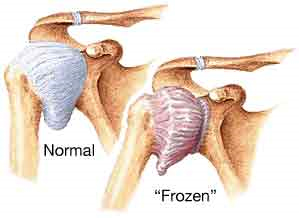
frozen-shoulder1Frozen shoulder, when it doesn’t move.


Frozen shoulder is a common diagnosis in the clinic. I have seen this problem treated in so many different ways that some PT’s are able to drive Escalades. The problem is that not all treatments are created equal. Educate yourself on what the problem is and how it can and should be treated. It’s your body…understand it at least.


  1. “Frozen shoulder, or adhesive capsulitis…painful and limited active and passive range of motion…reported to affect 2% to 5% of the general population”


To be frank, frozen shoulder means your shoulder is frozen…it doesn’t move. Adhesive capsulitis is the medical term for…your shoulder doesn’t move! If you take something that does’t move and you try to move it…it is painful. It is not as common as everyone would like to believe and honestly I rarely see it in the clinic. You can have a stiff shoulder and not necessarily have “frozen” shoulder. It affects those that are diabetic more often than those that aren’t, but aside from this, the reason for it is still not certain.


  1. “The absence of standardized nomenclature for frozen shoulder causes confusion in the literature”


We know some things for certain. Your frozen shoulder will go through stages from start to end, what we aren’t certain of is how many stages, and what do we call these stages?


  1. “Secondary frozen shoulder was defined by 3 subcategories: systemic, extrinsic, and intrinsic…secondary frozen shoulder related to insulin-dependent diabetes are more likely to have a more protracted and difficult clinical course”


If you have frozen shoulder because of some other problems, this is classified as secondary. If that problem is due to a body disease, extrinsic is due to an injury outside of the shoulder and intrinsic is a known problem of the shoulder.


  1. “another classification system based on the patient’s irritability level (low, moderate and high) that we (the authors of the journal article) believe is helpful when making clinical decisions regarding rehabilitation intervention…Patients with low irritability have less pain and have capsular end feels with little or no pain; therefore, active and passive motion are equal and disability lower…typically report stiffness rather than pain as a chief complaint…high irritability have significant pain resulting in limited passive motion (due to muscle guarding) and greater disability…pain rather than stiffness…”


This is very easy to follow…walk with me. Your irritability is literally that, when you move how irritating is it? If it is not that painful and you have a capsular end-feel (only to be determined by someone that has moved thousands and thousands of shoulders so that it can be determined if the joint is normal or not very moveable), then it is lower on the scale of irritable. If your shoulder feels like a hot poker stabbing you in the eye and twisted every time you move the shoulder…it’s probably highly irritable.


  1. “recent evidence identifies elevated serum cytokine levels as part of the process. Cytokines and other growth factors facilitate tissue repair and remodeling as part of the inflammatory process…sustained inflammation and fibrosis…although the initial stimulus is unknown.”


This is HUGE, for those that are nerdy regarding physiology. Tendonitis…doesn’t exist. That’s a lie, but not far off. When you think that you have a tendonitis, by the time you see a doctor, it is probably a tendinosis. This means that after a short period of time, there are no longer inflammatory markers (chemical of inflammation) in the tendon. The fact that there is sustained inflammation is…NO GOOD! Think about having constant cycles of inflammation going on in your body. It sounds painful. It is! Others have challenged the premise of adhesive capsulitis, in that the capsule itself doesn’t have the inflammatory markers. At this time, it is semantics, because the shoulder is still painful.


  1. “3 sequential stages: the painful stage, the stiff stage and the recovery stage” others have described “4 stages…the preadhesive stage, the acute adhesive or freezing stage…the fibrotic or frozen stage…the thawing phase” these phases may take 12-18 months and “mild symptoms may persist for years”


Although we can’t fully agree on how many stages and how to describe the stages, we know that this is will take a long time in order to become fully functional.


  1. “A full upper-quarter examination is performed to rule out cervical spine and neurological pathologies”


I can’t stress this enough. Just because your shoulder hurts, doesn’t mean that your shoulder is the problem. I refer to the spine as the great chameleon. It can mimic damn near any symptom that you experience in the periphery. If you don’t fully evaluate the spine…or at least take a quick peek…then you may be treating the wrong thing!


  1. “typically reveals significant limitation of both active and passive elevation, usually less than 120 degrees”


Quick lesson, active elevation is your ability to raise your own arm. Passive elevation is your ability to allow me to raise your arm. Those with rotator cuff tears or issues typically have horrible active elevation, but passive elevation is much better and may be normal.


  1. “Scapular substitution frequently accompanies active shoulder motion…” and “Cyriax described a capsular pattern he believed diagnostic for adhesive capsulitis…it is not consistently seen in patients with frozen shoulder when objectively measured.”


Scapular substituion is elevating the shoulder blade in order to perceive that your are raising your arm further overhead. I tell patients to look at the space between your shoulder and your ear. If there is a huge change in that space when raising your arm overhead, then something is wrong. Patient’s will understand this visual. Have them do it with their “healthy” side so that they can see how much space change actually occurs and then do it with the problematic side to compare.


Cyriax, think Alfred Hitchcock look-alike, is one of the greats that provided many thoughts in the infancy of our profession. His theories are still taught in school and we still have to memorize his paradigms for examinations. In real practice though, we don’t always follow his teachings because…they aren’t always right. Each therapist will learn through seeing thousands and thousands of shoulders, that his patterns aren’t always right, but aren’t always wrong.


  1. “Although authors of textbooks have described patients with frozen shoulder as having normal strength and painless resisted motions…revealed significant weakness of the shoulder internal rotators and elevators.”


In school we learned that frozen shoulder doesn’t affect strength. I am not sure if it is still being taught, but I have to believe so because the boards (think OWL exams from Harry Potter) are based on the text books and not on recent research. Regardless, theses patients do demonstrate weakness. In my opinion, this weakness may be related to disuse due to pain or pain inhibition, but that is a story for another day.


  1. “Significant loss of passive external rotation with the arm at the side, as well as loss of active and passive motion in other planes of movement, differentiates frozen shoulder from other pathologies…Early frozen shoulder may be difficult to differentiate from rotator cuff tendinopathy because motion may be minimally restricted and strength testing may be normal”


Big picture…frozen shoulder will present with multiple losses of motion in many planes. Early frozen shoulder will still have ROM limitations, but not as bad as those that are in the second stage, which may make it difficult to see at first. The therapist/MD may not immediately recognize frozen shoulder and the treatment may be inconsistent with what is needed.


  1. “The definitive treatment for frozen shoulder remains unclear…Establishing treatment effectiveness is also difficult because the majority of patients with frozen shoulder significantly improve in approximately 1 year; therefore, natural history must be considered”


In other words, we think we know how to treat it, but even if we don’t you will get better over time. Is it possible that you don’t need to come to therapy…of course! Will you benefit from therapy…of course! Even if the therapist is providing stuff that doesn’t work…like ultrasound…the therapist should be spending adequate time with you in order to educate you regarding the condition and the overall prognosis. If your health care provider is not doing this…walk away! There are therapists on almost every corner if you look hard enough. Find one of quality.


  1. “Explaining the insidious nature of frozen shoulder allays the patient’s fear of more serious diseases…prepares the patient for an extended recovery…because daily exercise is effective in relieving symptoms”


This is my primary job…education. I gave up a career, as a teacher because I felt the system was broken. It is too hard to teach a group of kids when I had to cater to lowest common denominators. In this profession, I am still a teacher, but I only have one student…the patient in front of me. If I can teach you everything you need to know in one visit and you will go out and be the perfect patient, I may never have to see you again…for this at least. Most patient’s can’t absorb everything and may not be overly compliant after the first visit, so more visits will be needed. My hope is that the frequency of our meetings will decrease over time as the patient takes more ownership over lifestyle changes and exercise performance. Alas…sometimes it never happens.


  1. “Little data exist supporting the use of frequently employed modalities such as heat, ice, ultrasound, or electrical stimulation.”


If this comprises a majority of your therapy…”Houston, we have a problem”. I’ve said it before and I’ll continue to stand on the soap box. Health care is a business. All businesses need to keep the doors open and it would be nice if there was a profit at the end of the day. This means that you will be charged for unsupported treatments because of the following reasons: 1. Patients expect this, as this has traditionally been sold as physical therapy 2. It feels good 3. It pays well.


  1. “Gursel et al demonstrated the lack of efficacy of ultrasound, as compared to sham ultrasound, in treating shoulder soft tissue disorders”


It is no better than a placebo! If you would pay for it out of pocket, then I would rub some lotion over you with an ultrasound and then tell you that it is not effective. Would you still pay for it? If the insurance covers it though…why not? I will tell you why not…it takes up valuable time that I could be focusing on something more effective.


  1. “The basic strategy in treating structural stiffness is to apply appropriate tissue stress…think of the total amount of stress being applied as the ‘dosage’, in much the same way that dosage applies to medication…adjusting the dose of tissue stress results in the desired therapeutic change”


Tissue stress is anything that stresses the tissue. I know that it sounds simple…DUH. It is. I can stress the tissue by squeezing the tissue, stretching the tissue, forcing the tissue to contract against an outside force, but in the end, I need to provide the “appropriate tissue stress”. If the tissue is shortened, then it needs to be lengthened. This occurs by stressing with stretching. You will have to follow a prescribed set and repetition scheme at a specific interval frequency, which will be given by your therapist. Typically this is performed no earlier than every 12 minutes and no later than every 3 hours.


  1. “Three factors should be considered when calculating the dose…intensity, frequency and duration.”


Think of these as variables. Any good scientist knows that the best way to find the variable most important is to only change one variable at a time. If the patient presents to therapy and is not making progress, then I can change any of the three variables. I will choose to change the variable that 1. Best fits with the patient’s schedule 2. Gives me the lowest chance of making the patient worst 3. Gives me the predicted best result. All in this order. If I give you an exercise that you can’t do, then it doesn’t matter if I believe that it will help you. For instance, if I give you an exercise that needs to be done lying, but you work in a sewer system, you may not like me after the exercise.


  1. “Aggressive stretching beyond the pain threshold resulted in inferior outcomes in patients…tissue stress is progressed primarily by increasing stretch frequency and duration”


Going to therapy 3 days per week and expecting the therapist to get you better is a pipe dream. If you only go to the therapist for stretching, then the intensity will be high. This will result in an inflammatory effect, in which you will not want to/be able to move your shoulder. At this point, the stiffness will worsen. Be smart and move to tolerance. If you are worse for more than 20 minutes after stopping, you made a mistake and went too intense (there is research to support this timeline, but I don’t have it onhand).


  1. “Patients with the worst perceptions of their shoulder before treatment tended to have the worst outcomes.”


Butterflies and rainbows. If you think you are disabled, then you are. Please move. PSA.


  1. “Many authors and clinicians advocate joint mobilization for pain reduction and improved ROM. Unfortunately, little scientific evidence exists to demonstrate the efficacy of joint mobilization over other forms of treatment for frozen shoulder.”


I can easily spend 20 minutes mobilizing your shoulder and small talking about the weather, politics and religion. How else are we going to talk for 20 minutes?! That’s a long time for me to hold your arm. I need something to pass the time. The evidence is conflicting regarding me pressing on your shoulder to try to free up some room. I do mobilizations sparingly. They are good to know and if nothing else is working, then sure…why not do them? If something else works better, then that’s why I don’t do them often.


  1. “improved extensibility of any portion of the CLC (joint capsule) results in improved motion in all planes.”


I love using this example in the clinic: There was an episode of Seinfeld in which George and Jerry were staying in a fancy hotel. George went on this rant regarding tuck vs no tuck. Big picture…when the sheet is tucked in too tight, it is impossible to move your feet. You have to loosen up the sheets by kicking at them. Once you’ve loosened it up a little, it seems to free up a ton of room everywhere. This is the circle concept of the shoulder.


When we loosen up on aspect of the capsule, then the laxity that is created just moves around the capsule through additional mobilizations. We don’t actually stretch out the capsule in multiple planes.


  1. “At 7 weeks, 77% of the patients treated with injections were considered treatment successes, compared to only 46% treated with physiotherapy.”


Hell, this stat makes me want to advise patients to do this first before seeing me…or start gambling for the night. Does anyone else see the 777?


  1. “The core exercises include pendulum exercise, passive supine forward elevation, passive external rotation with the arm in approximately 40 degrees abduction in the plane of the scapula and active assisted ROM in extension, horizontal adduction and internal rotation”


We spend a fair amount of time discussing this diagnosis in PT school. I wish they had just covered this type of study so that we would know the way to treat this type of patient, instead of all of the theories and possible ways to treat this patient. It is good to have understanding, but it is better to have successful outcomes.


Excerpts taken from:


Kelley MJ, Mcclure PW, Leggin BG. Frozen Shoulder: Evidence and a Proposed Model Guiding Rehabilitation. JOSPT. 2009;39(2):135-148.

How do you make the clinic better?


What are you doing to make your company better? If you are employed, then it is your company. Take stock in your employer. If you can make your company more efficient, then you deserve a raise. None of us should be getting raises for time served. It is not prison, at least it shouldn’t seem like prison. Find your passion and follow it. If you don’t have passion for at least one part of your job, then reassess your career path. Once you find IT, then make yourself valuable.


  1. “Process changes entails ‘looking for changes we can make within our system to become more efficient’”


If we believe that no system is perfect, and we can look at our own system (regardless of the profession or business) to ask ourselves ‘How can we be better’, then this will open Pandora’s box. For instance, I recently asked myself what can we as a department be doing better. There were a lot of suggestions that were thrown out. We delved into one suggestion and it a brick wall when we broached a certain subject. Pushing further, it turns out that another department limits our department. Our conversation didn’t go any further than this, but I would love to be in an upper level position to be able to bring the two departments together in order to demonstrate to the two departments how closely entwined they are with each other. This was just one suggestion of improvement that I discussed with my supervisor. In my opinion though, things will never change if they are never analyzed.


  1. “’In the end, whether it’s a clinical process or an operational one, anything you do that is part of that process must create value for your customer’”


Who is our “customer” in healthcare? The easy answer is the patient, but that answer is too easy and cookie cutter. I would challenge that answer. That is one of our customers, but maybe not THE customer. When we look in terms of retail, who is the customer? Is it everyone that is in the store…in an ideal setting, the answer is yes, but realistically our customer is the one that is spending money on our wares. In PT, the wares are PT. The customer (the one giving us the money) though is not the patient as much as it is the insurance company. How do we best create value for our payers? We fix our patients, which some believe to be our customers. This is not to demean the patient by any means, but we have to understand who feeds us. If the patient’s had to pay our of pocket, then I would say that the patient is the customer and that would create a different set of values.


  1. “Michael Porter, PhD, in The New England Journal of Medicine…defines value ‘as the health outcomes achieved per dollar spent.’…’Value should always be defined around the customer, and in a well-functioning health care system, the creation of value for patients should determine the rewards for all other actors in the system…value in health care is measured by the outcomes achieved, not the volume of services delivered…”


What this is saying is that the health care providers (therapists in this specific example) should get paid for doing a good job (meaning the patient gets better and avoids other costly procedures such as MRI’s, surgery, prolonged loss of work, etc) instead of getting paid for DOING a lot of stuff to the patient. In my opinion, this means that if you have back pain, then the therapist should get paid a certain amount for a specific outcome. If this outcome occurs in a short period of time, then the therapist makes more money per visit overall. There is value though in identifying patients that will not benefit from therapy and the therapist should also be rewarded for getting this patient to the proper practitioner to fix the problem. Another way to say this is that the therapist should be “punished” by having to refund money to the payer if the patient needs to undergo a surgery that the therapist though was avoidable. If we save the health care system a lot of money by avoiding surgery, then we should see a percentage of that health care savings. On the flip side, if we stated that the patient would do well with therapy and the patient did not do well, or needed surgery, then the money that we were paid should have to be paid back in order to help pay for the surgery. This is opening up a box, but as I stated before, the cream will rise to the top and those that are good at their job will learn how to maximize income by becoming better at fixing those that can be fixed and referring those that can’t be fixed on to someone else that can fix the patient.


  1. “Companies are seeking ways to reduce costs in response to health care reforms and in anticipation of the ever-closer move away from fee for service and toward value-based care”


This is all fine and dandy, but the companies need to inform the employees what is happening in the health care world. There are many companies, mine included, that have cut jobs, which has created a more stressful environment company-wide. We all hear, do more with less, but what should be said is that “we are getting paid less and have to get creative in order to continue to stay solvent”.


  1. “…the patient is the customer. Value, therefore, depends on patient experience…outcomes are greatly influenced by the amount of time the patient spends with actual caregivers”


My company does some things right and some things wrong. We need to assess the patient experience. This starts well before the patient is actually sitting in front of us for an evaluation. When the patient pulls into your business, is the entrance marked appropriately? Are you easy to find? Did your receptionist ensure that the patient had directions to get to your clinic? Now that the patient has found it, how easy is it to park? Does the patient have to walk a long way in order to see the clinician? Is the waiting room busy? Is the waiting room cluttered? Is the waiting room clean? Is there coffee? Is there demographic based reading material in the waiting room? Is the front desk staff warm and receptive? Does the front desk staff make an effort to remember patient names? When the patient registers for the first visit, are they simply handed paperwork to fill out, or does the receptionist offer to help? After registered, does the therapist come to the patient, or is the patient brought back to wait for the clinician? Is it a long walk to get to the clinic? Are there private rooms (or at least a private area) available to talk candidly with the patient, without the patient feeling stifled due to outsiders? Are the beds clean? Is the room inviting to the patient? Does the clinician have all the tools needed to take care of the patient?


This only describes the first 5 minutes of a patient experience and it can go on and on? Are companies still thinking about the patient experience, or simply the $$$.


I can say that my company does not ask me to violate any ethical considerations and as long as the patient is in the clinic, I am with the patient and caring for the patient. That patient is vulnerable, that’s why they are there, and I do my best to ensure that the patient understands that they are in a caring environment. This doesn’t always mean that I can help or “fix” the patient, but the patient understands that they will learn, be cared for, and get their money’s worth in the session.


  1. “The goal is to minimize the amount of time any patient must wait to be seen once he or she has called to make an appointment…3 days or less”


I have seen wait lists of up to 2 weeks to see the practitioner of choice. This is absurd. If the patient has to wait, the therapist better be fantabulous. This is uncalled for to have a wait list longer than 3 days. My first job, we prided ourselves in getting the patient in the clinic within 24 hours if the patient wanted to be seen.   It meant sacrifice at times, but the patient was always my priority.


  1. “…examining the department’s intake procedure, its insurance verification process, and even the performance of individual PT’s who might become more efficient by changing some of their protocols”


All businesses, healthcare is not an exception, could stand to become better. There are many avenues in which to improve, as I listed many instances, which could be evaluated in the first 5 minutes of a patient experience. Could the therapist be better? Of course! Is the therapist doing something to become better…highly unlikely…unfortunately. (This is simply my observation over the course of 8 years in practice. Once we start getting paychecks and life happens, the professionalism and giddiness that we entered the profession with starts to get pushed down by other priorities)


  1. “Lean…all about continuous improvement-taking every functional area of your practice, business, department, or organization and continuously challenging everyone who is part of it to do things better.”


This can be scary. Imagine having someone telling you that “you suck”. Scary right?! It will never happen, but unfortunately, it’s what we hear when we are told that we have to change. We can all be challenged, but how we are challenged is what matters.


Story time: Sam’s club 8298 Joliet IL. The year was about 2002 and a new GM came to the store. David was a good leader. I was working in Tires at the time and there were about 4 of us in the department on this day. He asked me to do one job and report back to him when I was done. No one else was asked to do anything more, so I was the only one working while everyone else waited for the next customer. After the first job, he gave me another…and another…and another. Six hours later, I was frustrated and angry because I was the only one working. I confronted him about it after 6 hours and he said something along the lines of wanting to see how much he could push me before I pushed back. He was surprised that it took 6 hours, as he though it would take much less. I respected him more for that, only because he told me his end-game.


  1. “It (Lean) allows you to find the steps that are not providing value so you can eliminate them.”


Change is hard. It is hard to change what has always been done, but if no one looks at “what has always been done”, then we will never know if it can be done better, or needs to be done at all.


  1. “incremental changes are made to a process and either accepted or rejected depending on the results”


This is similar to what we do in an evidenced based version of healthcare. We attempt to change one variable and note the result. If the result was bad, then we change back to what we were doing originally and attempt to change a different variable in order to make the patient better. This is the same concept, just applying to business instead of patient care. The trick is to allow the variable some time in order to allow itself to show its change. For instance, if I were to offer valet parking, I couldn’t assess it in one day. It may take time for my patients to realize that this is offered and even longer still for it to become an everyday occurrence. When it is established, I can then take inventory on whether it is good/bad/indifferent and if the valet needs to be improved or eliminated.


  1. “You’re continuously making changes, but they’re easy to reverse…if you do something that doesn’t lead to significant improvements, you go back to what you were doing before.”


This is very self explanatory, but I rarely see it put into practice. Complacency is the killer of excellence.   Unless we are constantly striving to improve, then we will be passed up by those that are.


  1. “if you want to come in and start your therapy today, you can, and you can make your appointments for whenever is most convenient for you. You just have to be willing to see different therapists”


This is a very simple concept, but if the patient is never made aware that they will be seeing different therapists, then the patient may not be as happy with the convenient time as they would with the same PT. This is something that my current company has tossed around, but has not taken 100% initiative with.


  1. “I would encourage any PT to see the journey in their setting from a patient’s perspective”


What would my patient’s think about their experience? I believe that the clinical aspect is covered thoroughly, but is there something else that I could be doing to enhance the experience?


  1. “Patient’s were starting late because it was taking too long to do all the paperwork. In that case, she says, ‘We brought everyone together to look at all the ways we had patients register. We then figured out what was absolutely necessary-as opposed to what we were doing just because we’d always done it that way…managed to reduce the average intake time by almost 10 minutes”


This is huge for me. I hate that I have to wait for a patient to complete all of the paperwork on the initial evaluation. When I have to wait for the patient, I am left with 2 options: cut the session short so that my next patient doesn’t have to wait, or make the next patient wait. Who is more important at this stage? It would be ideal for the patient to be completely registered prior to coming in for the first appointment. Why can’t this be done when the patient comes in to schedule?


  1. “’…quiet the external noise’ that too often exists in workplace environments…When we reduce that volume of noise, we free up our clinicians and frontline workers.”


This is interesting because this exact line was used in a previous e-mail from an employer. Unfortunately, just saying it doesn’t do much if the “leadership” doesn’t follow the same line. Noise could be anything from rumors, complaints, internal bullying, and anything that makes the frontline dissatisfied.

For the audio version, click the link

Link


Excerpts taken from:


Hayhurst C. Why Physical Therapists Are Embracing Lean Management. PT in Motion. December 2015-January2016:24-28.