Power cleans

This is a higher level exercise in order to increase power output and increase strength specific to this type of movement. There may be carry-over to jumping or lifting objects to shoulder height.

This exercise works many of the muscles of the body with an emphasis on the posterior chain.

You’ll see my heels leave the ground, which works the calf muscles. The knees go from bent to straightened, which work the quadriceps. The hip moves from closed to open, which works the glutes/hamstrings. The muscles of the back work to maintain positions and keep the spine from slouching. The arm and shoulder muscles work to pull the weight and hold the weight on the shoulders.

You can see that as the weight gets heavier that the technique breaks down. This is similar to everyday scenarios. For instance, if you have the strength to stand up from a chair without your arms over 10 times, we could work on technique, but if you can’t do one then your body will try to find the most convenient way to make it happen…even if the technique is not the best.

Any questions comment below.

It’s how winning is done!

“…distress among clinicians had been understood primarily through psychological concepts such as stress and burnout, which, although relevant, were not sufficient.”

Part of the reason that burnout is not purely psychological is because this model dictates that the person doesn’t have the tolerance for the mental aspect of the game that is being played.

My game of choice is physical therapy.  Burnout is happening in this profession and it still baffles me at times, but I am starting to have a more thorough understanding of it as I apply research from other sectors to our profession.  For instance, there are therapists that pride themselves on treating multiple patients per hour.  Some therapists are able to handle the load of multiple patients, but once they understand the purpose of treating multiple patients at once, said therapist may no longer feel proud of doing this.  Some clinics need to treat multiple patients per hour to keep the doors open, which is noble for the therapist to feel like he/she is greatly helping the clinic, whereas others are doing it only to fatten a pocketbook.

“shortages of resources, such as shortages of time and staff, led to dispiritedness, a lack of respect, and an absence of recognition for both patients and staff, all of which severely diminished the ability of staff to provide high-quality care.”

In healthcare, it’s all about how much work can be done in a specific time period.  This is measured by patients seen/hour or units billed/hour or dollars made/day.  We are always being asked to do more with less.  Guess what? Us and almost every other industry out there.  This is not just healthcare, but in a limited scope its what we focus on here.  Because of this, some may feel unappreciated and believe that the big bosses (administration) don’t see our struggles.  We can either play the victim or we can take action.

I don’t know if I agree with the last part of the statement “diminished the ability” etc.  The ability has not changed.  The skills have not changed.  The personal drive should not have changed.  I have worked in environments where morale was down because of this exact scenario and still never understood it.

We make choices everyday.  We made a choice when entering this profession that we would place the patient’s needs above all else.  I made that choice.  I have to live with that choice and can’t allow other outside influences to impede the decision that I made.

I think that more in the healthcare profession need to go back and examine their personal mission. Mine is short and sweet.

“The consequences of moral distress for nurses and other health care providers include feelings of anger, frustration, guilt, and powerlessness.”

I’ve seen this firsthand.  People stop caring.  It’s sad to walk around in an environment where the employees don’t feel heard.  If things in an specific environment always remain the same, then where is the impetus for change? Are you a flea?

“…moral distress can also occur when clinicians internalize external constraints to such a point that their own moral values begin to shift, causing them to disengage morally, compromise their integrity, and possibly engage in harmful practice.”

I have had conversations with those that enforce the rules (read that as members of the department of justice) and there was something said that has stuck with me all these years. To paraphrase: people don’t start out with the intention to deceive, but they may slightly overbill every once in a while.  If they don’t get caught, then there is no external pressure not to do it and then other vices take over such as greed.

Understand the why behind actions and it is easier to understand the actions.

“…moral resilience, which can be understood as ‘the capacity of an individual to sustain or restore [his or her] integrity in response to moral complexity, confusion, distress, or setbacks.'”

Some people are just stronger.  That’s not wrong to say.  It holds true in many aspects of life.  I am a bigger guy, so I am in the bottom half of runners.  I’m just not a strong runner.  I have seen people get shot.  I’ve had friends killed.  I’ve had family in prison.  I’ve seen bad stuff.  I have a stronger resilience to bad stuff than others and I don’t tend to panic quickly.  I know…I know… “I have a high pain tolerance.”  I hear it all the time from patients, but I believe that my moral compass is on point because of my experiences.  I don’t believe that there are many in healthcare with my experiences.

Question of the day:

Do you have moral resilience?  This means can you stand up for what you believe in or are you going to get knocked down and not have the ability to stand up for yourself again?


Excerpts take from:

Rodney PA. WHat We Know About Moral Distress: Looking over three decades of research and exploring ways to move the concept forward. AJN. 2017;117(2):S7-S10.


Giving back

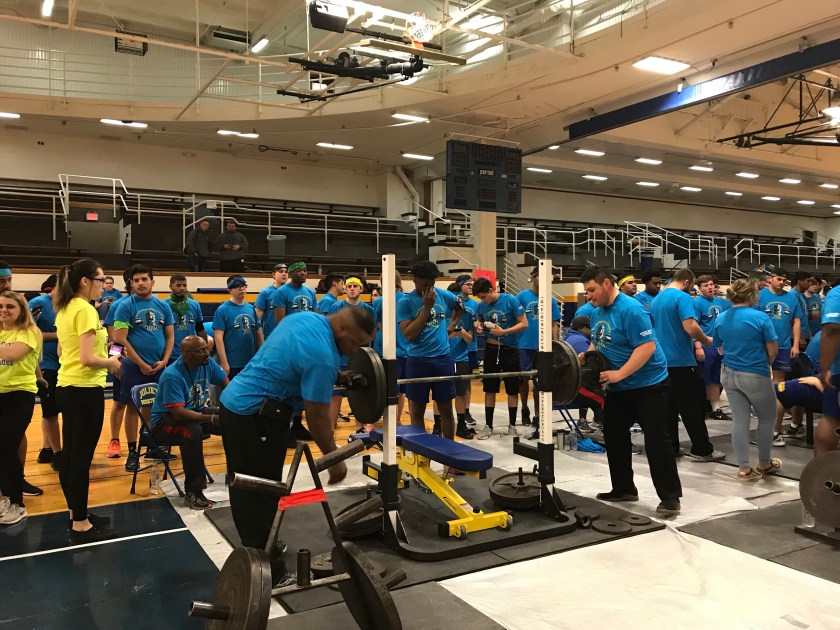
We all have our own way of giving back. This event was hosted by Joliet Central and is a memorial to one of the former teachers, Dave Christiansen, killed by a drunk driver.

Jennifer Christiansen, Dave’s wife, andGardner Coughlin are both teachers at Joliet Central and reach out to lifters in the community to see if they can lend a hand.

It was an honor to load bars and spot these kids because I stood side by side with my mentors in powerlifting from years gone by.

Enjoy the photos and videos.

Dr. Vince Gutierrez, PT

Moral Distress and Moral Resilience

“At the individual level moral distress may cause burnout, lack of empathy, and job dissatisfaction, while at the organizational level it may lead to reduced quality of care, increased staff turnover, and poor patient outcomes.”

Moral distress is essentially knowing the right action to take, but being unable to take that action due to external conflicts.  For instance, in therapy we may believe that a patient only requires one visit per week, but the corporation may place pressure on the therapist to see the patient more often during the week.  Again, this decision may be due to corporate pressures to make more $$$.  If you are the therapist, you are now in the middle of doing the right thing by the patient (at least what the therapist believes to be the right thing) and doing the right thing by the company.

You can see a quick link here speaking to some of the pressures felt by staff PT’s to keep patients longer than “needed”, in the therapist opinion.

When employees feel this pressure, they start to believe that the initial reason for getting into healthcare, “to help people”, becomes trumped by the need to make more money for the company.  This difference of personal moral code and corporate code has been shown to lead to moral conflict.

Can you see how this could lead to staff turnover? Of course, when the therapist’s personal mission is not in alignment with corporate mission, it may cause the therapist to find a new job that best matches personal mission.  It has been said that Millenials are very concerned about a corporate mission matching a personal mission.

One can logically make the jump from a lack of empathy (not listening or understanding the patient’s position) and job dissatisfaction to worsening clinical outcomes.  All of this makes sense to me.

“Generally, resilience refers to ‘the ability to recover or healthfully adapt to challenges, stress, adversity, or trauma'”

I love using this when talking to patients about tissue ability to absorb force and unexpected events.  When talking about moral issues, it has to do with a person or therapist’s ability to absorb stress without significant setbacks in emotional or physical well-being.

The article went on to create recommendations for addressing moral distress and moral resilience.

“Institution leaders need to value and create a culture of ethical practice and commit resources to support individuals in cultivating moral resilience”

Many statements can sound great, but creating a culture of ethical practice may be near impossible in all practices.  From the top there is a culture that leaks downwards onto the worker bees.  This company will assume the “culture” of the owner, if not in whole, at least an iteration of the owner.  This is where I believe that having a thorough understanding of one’s own personal mission is vital because otherwise one may assume another’s mission and waste years or decades on a mission that one doesn’t own.

“Encourage accreditation bodies to mandate that curricula for all health care professions include content addressing ethics, moral distress, and moral resilience”

I fully disagree!  Whaaat?!

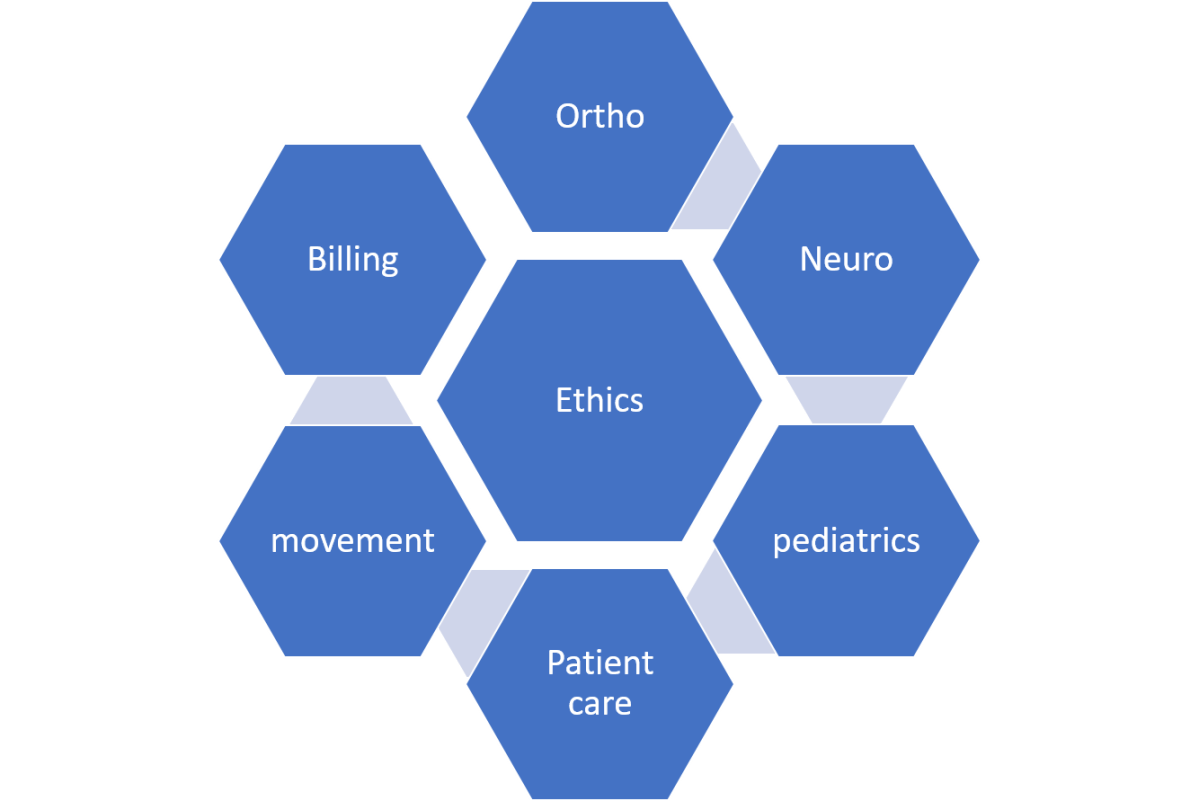
I don’t think that the curricula should include ethical content, but ethics has to be embedded within all of the curricula. Here’s my rendition of an ideal program set-up.  The ideas on the periphery can always change, but they must center around creating an ethical professional.
ethical curriculum

The ethical issues that are noted across the lifespan will differ and the ethical issues noted in business are a completely different animal.  Because of this, it is important that topics are brought to the students attention so that they have some background from which to make a decision.

I also don’t think that this should be taught by the professors at the universities.  In terms of treating in the trenches, most of academia that I come in contact with haven’t practiced full time in a clinic in a long time or ever.  Because of that, there is a lack of “street cred”.  It’s hard to discuss and own a topic if there is no experience in the topic.

We had a teacher in PT school that would always say refer to Reese and Bandy (authors of a book), whenever we brought a question.  At first, I thought that she wanted us to obtain the answers for ourselves, but over time I learned that the professors (plural) teaching that class 1. didn’t know what was in the book and 2. couldn’t rationalize the ideas that were in the book.  They had me refer to a different teacher altogether in order to have him explain the concepts in the book that were contradictory.

Ethics has to be taught from experience…in my opinion.


Excerpts from:

Rushton CH, Schoonover-Shoffner K, Kennedy SM. Executive Summary: Transforming Moral Distress into Moral Resilience in Nursing. AJN. 2017;117(2):52-56.


Moral Distress and Moral Resilience

“At the individual level moral distress may cause burnout, lack of empathy, and job dissatisfaction, while at the organizational level it may lead to reduced quality of care, increased staff turnover, and poor patient outcomes.”

Moral distress is essentially knowing the right action to take, but being unable to take that action due to external conflicts.  For instance, in therapy we may believe that a patient only requires one visit per week, but the corporation may place pressure on the therapist to see the patient more often during the week.  Again, this decision may be due to corporate pressures to make more $$$.  If you are the therapist, you are now in the middle of doing the right thing by the patient (at least what the therapist believes to be the right thing) and doing the right thing by the company.

You can see a quick link here speaking to some of the pressures felt by staff PT’s to keep patients longer than “needed”, in the therapist opinion.

When employees feel this pressure, they start to believe that the initial reason for getting into healthcare, “to help people”, becomes trumped by the need to make more money for the company.  This difference of personal moral code and corporate code has been shown to lead to moral conflict.

Can you see how this could lead to staff turnover? Of course, when the therapist’s personal mission is not in alignment with corporate mission, it may cause the therapist to find a new job that best matches personal mission.  It has been said that Millenials are very concerned about a corporate mission matching a personal mission.

One can logically make the jump from a lack of empathy (not listening or understanding the patient’s position) and job dissatisfaction to worsening clinical outcomes.  All of this makes sense to me.

“Generally, resilience refers to ‘the ability to recover or healthfully adapt to challenges, stress, adversity, or trauma'”

I love using this when talking to patients about tissue ability to absorb force and unexpected events.  When talking about moral issues, it has to do with a person or therapist’s ability to absorb stress without significant setbacks in emotional or physical well-being.

The article went on to create recommendations for addressing moral distress and moral resilience.

“Institution leaders need to value and create a culture of ethical practice and commit resources to support individuals in cultivating moral resilience”

Many statements can sound great, but creating a culture of ethical practice may be near impossible in all practices.  From the top there is a culture that leaks downwards onto the worker bees.  This company will assume the “culture” of the owner, if not in whole, at least an iteration of the owner.  This is where I believe that having a thorough understanding of one’s own personal mission is vital because otherwise one may assume another’s mission and waste years or decades on a mission that one doesn’t own.

“Encourage accreditation bodies to mandate that curricula for all health care professions include content addressing ethics, moral distress, and moral resilience”

I fully disagree!  Whaaat?!

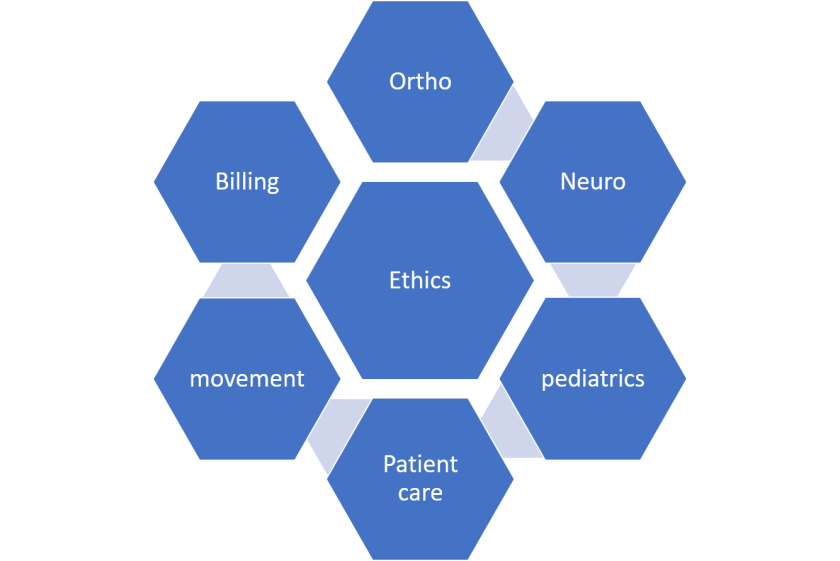
I don’t think that the curricula should include ethical content, but ethics has to be embedded within all of the curricula. Here’s my rendition of an ideal program set-up.  The ideas on the periphery can always change, but they must center around creating an ethical professional.

The ethical issues that are noted across the lifespan will differ and the ethical issues noted in business are a completely different animal.  Because of this, it is important that topics are brought to the students attention so that they have some background from which to make a decision.

I also don’t think that this should be taught by the professors at the universities.  In terms of treating in the trenches, most of academia that I come in contact with haven’t practiced full time in a clinic in a long time or ever.  Because of that, there is a lack of “street cred”.  It’s hard to discuss and own a topic if there is no experience in the topic.

We had a teacher in PT school that would always say refer to Reese and Bandy (authors of a book), whenever we brought a question.  At first, I thought that she wanted us to obtain the answers for ourselves, but over time I learned that the professors (plural) teaching that class 1. didn’t know what was in the book and 2. couldn’t rationalize the ideas that were in the book.  They had me refer to a different teacher altogether in order to have him explain the concepts in the book that were contradictory.

Ethics has to be taught from experience…in my opinion.

Excerpts from:

Rushton CH, Schoonover-Shoffner K, Kennedy SM. Executive Summary: Transforming Moral Distress into Moral Resilience in Nursing. AJN. 2017;117(2):52-56.

Why Rush

I came across this quote today in Black Belt Magazine. (Read topics from other fields because you will expand your knowledge and may find information that applies to your mastery).

This quote is perfect for the profession of physical therapy.

Are you in this profession for the long term?

If so, study every day. Learn a little bit every day. Master a topic every day. You have time to reach that mastery. You have you’re entire career to become a master at physical therapy.

If this is a stepping stone to something else (I ain’t gonna hate ya for it), then why bother to master anything at all?

If your goal is to go into the business of owning a clinic, teaching courses, becoming a professor, then it doesn’t matter if you “master the profession”. It only matters that you master that which is your goal.

Happy thought for the day.