
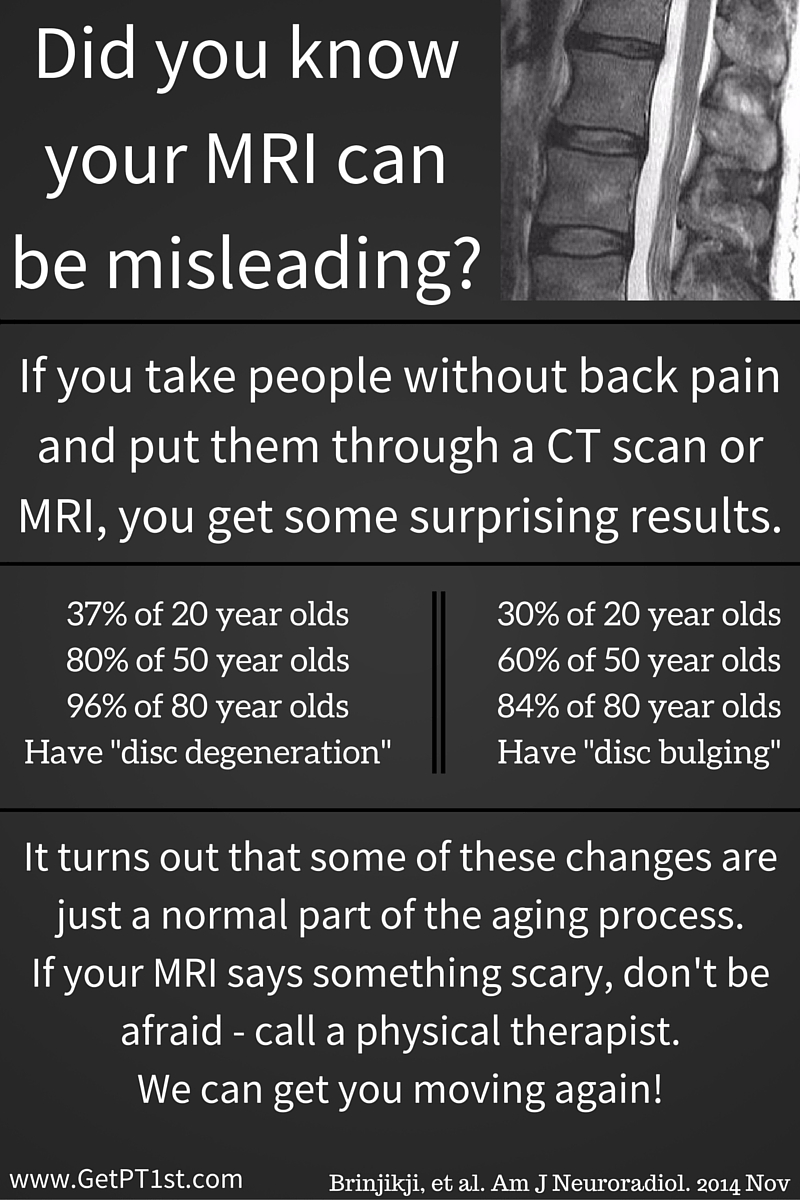
You are not your MRI..at least not for long

did-you-know-your-mri-can-be-misleadingYou are not your MRI…at least not for long.


MORAL OF THE STORY: Stop your whining over your herniated disc, bulging disc or exploding disc. You are probably not the outlier. If your pain is lasting longer than six months, your disc is probably healed, but you still move like crap. Start to move better and take better care of yourself and the improvements will follow. In general, this means that you are most likely the problem…not your back.

Also, I will be taking a couple of weeks off from reading and writing to travel with the family.  Taking some time to breathe.  If you enjoy the blog, please add a topic that you would like to see covered at a later date.


  1. “Lumbar disc hernia (LDH) is a common cause of low back pain and radicular leg pain…majority of LDH patients recover spontaneously…Purpose of the present study was to investigate the natural history of the morphologic changes of LDH on MRI and to assess correlations with the type of LDH and the clinical outcome”


First, disc herniations are a common cause of pain. I believe this to be true and the research consistently reports this fact. The part that doesn’t get reported is the second part of the statement being that spontaneous recovery is normal.


When people come into the clinic, they have this seemingly rehearsed story of how they had an MRI and was told that they have a bulging/herniated/exploding (maybe a little overboard) disc. The doctors never tell them that this can recover on its own and patients then wear the herniated disc patch for the rest of their lives.


As you will see, you no longer need to wear that patch if your were told that you have an exploding disc.


  1. “…42 patients…mean age of 42…unilateral leg pain and low back pain…symptomatic level was L2-3 in 8 cases, L3-4 in 6 cases, L4-5 in 15 cases and L5-S1 in 13 cases”


Let’s start here. l_spine
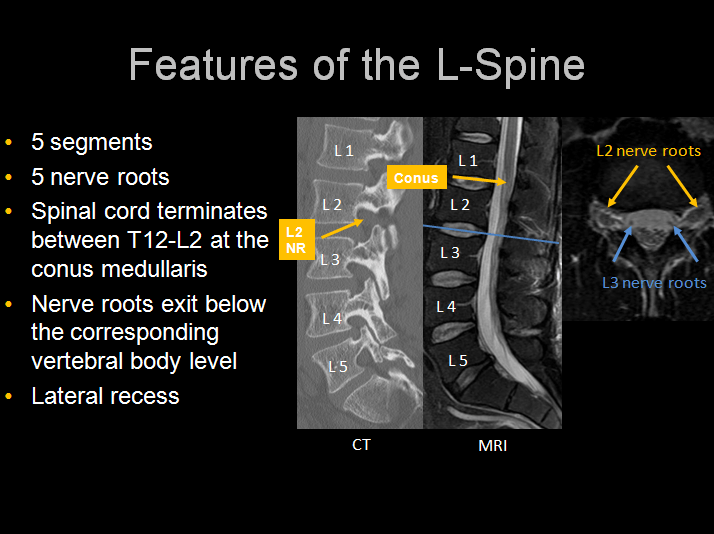
 

The lumbar spine is labeled as L1-5 and the sacral spine then starts. The intersection between the lumbar spine and the sacrum is L5-S1. The segments are named by the upper segment first-lower segment second.


Some interesting notes regarding this study:


  1. 66% of the patients have symptoms coming from the lower lumbar segments, those being L4-S1. This is inconsistent with published research reporting that up to 95% of symptoms come from these lower segments.
  2. Therefore, 34% of symptoms are coming from the upper segments. Again, previous research notes that only 5% of symptoms come from these segments.


Unilateral leg pain simply means that only one leg is affected. For those that may have experienced sciatica in the past, you will remember that it was only one leg that experienced symptoms. If you have symptoms in both legs, then it may not be sciatica.


  1. “All patients underwent MRI examinations every three months for a period of 3-24 months”


This is not affordable for most and won’t be approved by any insurance that I have encountered. The reason for the frequent MRI’s is to see how things change over time.


  1. “LDH was classified into three types: protrusion (n=7), extrusion (n=17 and sequestration (n=18)”


Here comes the jelly donut theory. If you have heard it, then you can pass this paragraph up. Think of the disc as a jelly donut (I know that this is an oversimplification, but this model makes the most sense…even if it is not the most accurate).


A protrusion means that the outer portion of the donut (the actual donut itself) has been deformed. If you plug the hole of the jelly donut so that the jelly can’t come out of the hole, you will be able to follow along with the rest of the idea. I personally don’t like jelly donuts. I much prefer custard or cream. Speaking of that, Tim Hortons has the best filled donuts that I have ever had. This reminds me of a trip to Canada with my best buddy Carl. If I have the time later, some stories from this road trip may come out. Back to business; if you squeeze the donut on an edge lightly, you will start to squeeze the jelly away from the area that you are squeezing. If you squeeze a little harder, you will see the donut “bulge” just prior to the jelly coming out. This is a protrusion.


An extrusion means that the jelly has escaped! Oh no! Now what? No big deal. You will see later that this may actually be a better situation for you than the protrusion.


A sequestration means that not only has the jelly escaped, but a piece has broken off and hit the floor. If enough nuclear material (the jelly inside the disc) breaks through the annulus (the donut in the example), then it may break off and be free floating in the spinal canal (near the nerves of the spine). This again may not be as bad as it sounds.


  1. Correlation between the clinical outcome and spontaneous changes of the herniated mass on MRI (6 months)


MRI change Excellent Good Poor Total%
Disappearance 6 2 0 19
More than 50% reduction 11 18 0 69
Little or no reduction 0 1 4 12
Total 40 50 10 100


What this means is that in 19% of patients, the herniation seen on the MRI disappeared over the course of time. Better yet, about 88% improved significantly over the course of time. You are not your MRI… at least not for long.


6.

Type of herniation Case Duration of symptoms
Protrusion 3 cases in total 3-14 weeks with 8 weeks average
Extrusion 17 cases 4-8 weeks with 4.8 weeks average
Sequestration 18 cases 1-5 weeks with 3.2 weeks average


What does this chart mean? Those that have a “more serious” appearing herniation on MRI actually respond faster than those with a smaller herniation. You are not your MRI…at least not for long


Excerpts taken from:


Takada E, Takahashi M. Natural history of lumbar disc hernia with radicular leg pain: Spontaneous MRI changes of the herniated mass and correlation with clinical outcome. Journal of Orthopaedic Surgery. 2001;9(1):1-7.

Sciatica of the Arm?

01-branch-615SCIATICA OF THE ARM


The great chameleon; the spine. It can mimick any symptom that you are feeling, or believe to be feeling. I can remember my first year in practice treating a patient with an amputation from WWII. He would tell me about his pain in the foot (which was no longer there). This is well before the mirror box studies became popular and the whole Graded Motor Imagery style of treatment. At the time I only knew directional preference and mechanical assessment procedures. Luckily for me, he fit the paradigm. This patient complaining of leg pain, without a leg, responded rapidly to repeated extension in lying.


Many patients will experience neck pain, which also radiates into the shoulder blade, chest, arm or hand region. I know, because I am also one of the 70% that will experience these symptoms in his/her lifetime. It was so bad that I had to go to the ER because I thought I was having a heart attack at the time. It doesn’t matter how much information may be known, chest pain is still no joke. After ruling out a heart attack, I was able to rapidly fix the chest pain through a few sets of cervical exercises.


When a person is experiencing symptoms that radiate into the arm, with associated neurological signs, such as weakness, numbness, or reflex loss, this is called cervical radiculopathy. There is a clinical prediction rule that is very strong for classifying patients with cervical radiculopathy, prior to the patient receiving any type of test, such as an EMG or NCV, while in the clinic.


We as therapists will do well to know the evidence. Whether we fall on the side of Chad Cook regarding CPR’s having little utility until they have been verified or we fall on the side of believing everything that is written, we at least have to respect the information and know it…more knowledge can’t be harmful when we have more options with which to treat patients.


Facts from the following:


Wainner RS, Fritz JM, Irrgang JJ, et al. Reliability and Diagnostic Accuracy of the Clinical Examination and Patient Self-Report Measures for Cervical Radiculopathy. Spine. 2003;28:52-62.


Introduction

  1. No universally accepted criteria for dx of CS radic have been est (2ndary)
  2. Useful to establish accurate clinical examination findings for a diagnosis of cervical radiculopathy
  3. Purpose of theis study was twofold: to assess the reliability and accuracy of

selected clinical examination findings for the dx of c/s radic using an electophysiologic reference criterion, and to identify and assess the accuracy of an optimum cluster of clinical examination findings for the dx of C/s radic.


METHODS

  1. 82 patients
  2. eligibility
  3. consecutive patients from 18-70
  4. suspected of CS radic or CTS
  5. Exclusion
  6. systemic disease that causes peripheral neuropathy
  7. primary report of bilateral radiating arm pain
  8. h/o condition affecting the UE interfering with function
  9. no work >=6 m 2nd to symptoms
  10. h/o surgical procedures for pathologies giving rise to neck pain or CTS
  11. Previous EMG and NCS testing for CR and/or CTS
  12. workman’s comp or litigation


patient self report items

  1. VAS
  2. NDI


Standardized Electrophyologic examination procedure

  1. Needle EMG and NCS served as reference criterion for radic


Standardized clinical examination procedure

  1. 34 items performed by examiner one after EMG and NCS
  2. same by examiner two after 10 minute rest to determine reliability
  3. blinded to EMG/NCS/PT 1 results


History:

  1. 6 questions thought to be diagnostic for CR


Conventional Neurologic Examination and Provocative Tests

  1. MMT of C5-T1
  2. Reflex of biceps, brachioradialis, Triceps
  3. absent/reduced, normal, increased
  4. Pin-prick sensation C5-C8


Provocative testing

  1. Spurling test A+B
  2. Shoulder abduction test
  3. Valsalva maneuver
  4. Neck Distraction
  5. ULTT A+B


Cervical ROM

  1. All inclinometer for saggital and frontal and goni for rotation


RESULTS:

  1. Prevalence of CR and CTS was 23% and 35%
  2. CPR
  3. ULTTA + (+LR 1.3)
  4. involved cervical rotation < 60 degrees (+ LR 1.8)
  5. distraction test (+LR 4.4)
  6. Spurling A (+LR 3.5)
  7. Two positive: +LR 0.88 PTP: 21%
  8. Three positive: +LR: 6.1 PTP: 65%
  9. All positive: +LR: 30.3 PTP: 90%


Clinical Utility: Three + tests increase the liklihood from 23% to 65%, which makes this cutoff worth looking at clinically. The fact that the PTP with all 4 is 90% is very clinically useful. With experience, I see that there are neurologists and orthopedic spine surgeons utilizing a version of this CPR . I am not aware if the study was read by these clinicians.

CPR…not that kind

In the PT world, those of us that follow the research like to quiz students on Clinical Prediction Rules, because these have become all of the rage in the Evidenced Based Practice world.  Unfortunately, few CPR’s have been validated through repeated testing and those that have are still being assessed in order to determine if the CPR actually changes the way that PT’s practice.  In my opinion the answer is no to this basic question. When we look at the clinical practice guidelines, it clearly states that manipulations are a tool to be used for patients with low back pain.

It would be great if all PT’s, in the outpatient setting were familiar and comfortable with performing grade V mobilizations (otherwise known as manipulations in the research).  This is an entirely different subject to begin with, but we should also go there.

Each profession owns certain terminology, and this varies by state.  For example, in the state of Illinois, chiropractors own the term manipulation, but therapists can use the term grade V thrust mobilization.  The end outcome is the same procedure, but we can get in trouble for performing interventions outside of our practice act if we call it by the wrong name.

Moving on to a gripe with the American Physical Therapy Association.  Many PTA’s are taught that they are not allowed to manipulate a patient.  The rationale for this is that when PT’s (Doctors of Physical Therapy) graduate from an accredited program, that the newly graduated PT is now considered an expert at performing the manipulations;whereas the PTA, because the topic wasn’t taught in school, is not an expert and therefore should not be performing the maneuver.  The problem with this rationale is that the APTA is greatly overestimating students’ ability upon graduating from a PT program.  Working closely with many students over the years, I have only had up to 3 students that were able to walk into the clinic on day one and perform manipulations without any cues.  This is up to 3 of 50 in total.  This is not a high percentage of students that are “experts”.  I would have to teach a PTA student in the same fashion that I teach a DPT student.  The maneuver didn’t change because the person’s title is different.  No where does it legally state that a PTA is not allowed to perform a manipulation.  I have worked with PTA’s that quickly grasp the concept and the mechanics of a grade V thrust mobilization and on the same note I have worked with many DPT’s that I wouldn’t want to perform this maneuver on a cadaver because the newly graduated DPT may get hurt.  That’s my axe to grind for the night.

Here’s my article for the night.  Not as exciting as above.

Beneciuk JM, Bishop MD, George SZ. Clinical Prediction Rules for Physical Therapy Interventions: A systematic review. Phys Ther. 2009;89:114-124.


INTRODUCTION:

  1. The purpose of the review was to determine the quality of CPR’s developled for interventions used by PT’s.
  2. included if the explicit purpose was to develop a CPR related to a specific

intervention approach for conditions commonly treated in PT.

  1. excluded if already validated (VG: This brings up a point: would the

previously validated CPR (manip LS) be approved based on the

criteria established in this article (topic for a later debate seeing that

the authors ask readers to examine the Type IV CPR prior to

attempting utilization).


METHODS:

  1. 18 criteria used to assess quality in the SR covering 8 qualities
  2. study population
  3. response information
  4. follow-up
  5. intervention
  6. outcome
  7. masking
  8. prognostic factors
  9. data presentation
  10. high score of 18/18 correlates with high quality
  11. taken from average of 3 reviewers per article.
  12. high quality is >60%
  13. 8 studies remained after the initial compilation of 25


methodological criteria

  1. items rated
  2. inception cohort
  3. inclusion/exclusion criteria
  4. Study Population
  5. Nonresponders vs. responders
  6. Prospective data collection
  7. Follow-up at >= 6 months
  8. Dropouts/loss to follow-up of <20%
  9. Inforation on subjects completing study vs. loss to follow-up/dropouts
  10. Intervention fully described/standardized
  11. Standardized assessment of relevant outcome criteria
  12. Masking of outcome assessor and treating clinician
  13. Standardized assessment of subject characteristics and potential clinical

prognostic factors.

  1. Standardized assessment of position psychosocial prognostic factors
  2. Frequencies of most important outcome measures
  3. Frequencieis of most improtan outcome measures
  4. Appropriate analysis techniques
  5. Prognostic model presented
  6. Sufficient numbers of subjects
  7. Five studies >60% (good quality), 4 rated 50-60%, 1 rated <50%


DISCUSSION

  1. Quality of derivation studies has never been assessed.
  2. Only 40% of the studies had adequate sample size.


CONCLUSION:

  1. Follow-up validation studies are needed.

Boys…put your balls away

MORAL: Boys, put your balls away. Nothing more to add


  1. “Developing core strength has been emphasized as a valuable component in general and sports conditioning programs in addition to active rehabilitation programs for individuals with low back pain (LBP).”


What is the core? We all see the late night infomercials talking about core strength and see people with washboard abs. Is this core? Not exactly. Picture this: the strike zone in baseball. Not the MLB, because that strike zone is almost non-existent, but little league baseball. The old middle of the thighs to the letters of the jersey, that’s the strike zone. Now, picture all of the bones and muscles that are in this area. Do the same thing for the side of the body and the back of the body. Most everyone neglects the back and sides. We all want that beach body you know. Unfortunately, that beach body is all show and no go.


Core stabilization is more of a communication thing than an Incredible Hulk thing. The muscles of the “core” (strike zone) have to be able to transfer the amount of force that your legs are generating and apply it to something that your arms want to do. All of the body by Jakes or ab rockers won’t get you there. They will do a great job of strengthening your target muscles for that specific exercise, but they won’t do anything for making you a better athlete or better person for that matter.


  1. “Numerous studies have placed individuals on trunk exercise programs that in turn resulted in a greater increase in endurance and decline in reports of LBP episodes”


If you are a couch potato, than doing anything may be better than doing nothing. If this is you, then stop reading because the ab rocker is waiting for the next set. If you aspire to more than just couch potato, then doing unweighted trunk strengthening exercises may not be enough for you.


  1. “It is apparent that training while under unstable conditions does increase the activity of these (trunk) muscles”


Enter the Bosu ball or the Swiss Ball. This one statement has created rooms of balls in gyms and has spawned people marching in place while sitting on a ball in the physical therapy clinic. If you are one of these people and really think that you are being uber effective, then this article may be offensive. PUT YOUR BALLS AWAY!


But I can already hear you say: “increased activity” blah, blah, blah. Look, being busy is not the same as being productive. Increasing activity does not lead to increasing strength, unless you are increasing the load as well. When I say load, I mean weight. The kind of stuff of the legends of Paul Anderson, Franco Columbo, Kaz (he is so legendary that he only needs to go by his nickname). Look these people up. I can say with certainty that they weren’t training on balls.


  1. “Behm et al had subjects perform various trunk-stabilizing exercises with stable and unstable (Swiss ball) conditions. Results indicated that the abdominal stabilizers, LSES (back muscles) and ULES (upper back muscles) exhibited significantly greater activity with the unstable conditions. The 2 most effective exercises for trunk activation were the side bridge and superman”


Again is you are weak than doing anything is better than doing nothing. If you have weak muscles, then lifting a spoon is difficult and your muscles will get activated. “Only the strong survive.” I don’t want to activate, I want to get jacked. Why? Because someone that is strong will be able to get their butt off of the toilet at the age of 80, without the use of handrails. Someone that is jacked will not have difficulty getting off of the floor and being a stereotype like on the commercial. People…it is not about turning on muscles. I can turn on my butt muscles by squeezing my ass cheeks together. Activation does not equal functional and surely doesn’t mean strong.


The Swiss ball is one of the worst things to be introduced into our profession. That’s right…I said it! We as a profession spend way too much time training unstable situations when the patient needs to get stronger. I can hear the PTs arguing now: “What about balance patients? What about patients that need to walk on unstable surfaces?” Great! Do Swiss ball stuff for this purpose, but stop selling the unstable training as a means to get stronger. I am saying “I AGREE WITH YOU”! Ok, now get rid of the Swiss ball for all other purposes. We are doing the patient a disservice. The logic made sense years ago, but the research just isn’t there.


On a side note: I want as many patients as possible to read this blog. This way the patient can be armed with facts to go into the PT with in order to question the activities that are being performed in the clinic. If I can’t give a good reason for why I am doing what I am doing, then fire me! We are in a day and age in which results will be the driver of our profession. This is already starting to happen with “bundled payments for total joints” ( I highly suggest that you educate yourself on this also. I may or may not write about this soon). We need to make sure that as health professionals that we continue to get smarter and better at what we do. Patients need to continue to educate themselves about their health for two reasons 1. IT’S YOUR BODY! 2. You will challenge your health care provider to either get better or get lost.


The two most effective exercises for trunk activation are the side bridge and superman, said no strongman, crossfitter or strongman ever!


  1. “Swiss balls have been incorporated into strength training programs on the belief that a labile surface will provide a greater challenge to the trunk muscles, increase the dynamic balance of the user and possibly help to stabilize the spine in order to prevent injuries”


Coming soon: Humans on Mars. Same kind of statement. The above quote starts by talking about beliefs. Look, are we a faith or are we a science? We can’t have both. If we believe something to be true…it also has to be true. For a long time, the world was flat. We believed it to be true, so it was true. We have come a long way since Galileo. We actually have to test our beliefs to see if it is worth using.


I am a meathead. Swiss balls are fun to play tug-o-war or work on balance (such as advocated by Paul Check), but they are not good for building stability. To be stable is to be the opposite of mobile. We need to make our trunk opposite of mobile. We can do this by resisting a heavy load.


  1. “…one must ensure that their training regimen incorporates training specificity”


Joe Weider. The name brings back memories of the old Weider barbell sets sold at Sears. We had the concrete filled plastic weights. My how far we have come…and yet the same principles still apply. If you want to get better at throwing a punch, don’t work on kicks and if you want to be a better swimmer, don’t practice skydiving. If we want to be strong and stable (i.e. immobile), then we need to practice on being strong and stable.


  1. “The practical application of training the trunk stabilizers from a supine or prone position may not transfer effectively to the predominately erect activities of daily living”


If we pair point 6 and point 7, then there’s only one real reason to practice exercises in a horizontal position…you know what I mean (wink, wink).


Anyway, the new buzz words are functional fitness. The above statement is essentially saying that doing exercises that are not similar to what you would do during your day may not be functional. You hear the old joke about 12 oz curls, yeah I’ve heard it too. If all you do all day is drink grape nehi, then you don’t need to do anymore than that. It’s functional for you.


  1. “Perhaps a combination of relatively high-intensity resistance using free weights (light to moderate instability) can provide greater activation than the very popular instability exercises commonly used today”


DUH! Anyway, the authors are finally talking about a quantity of activation. There is no doubt that lifting a beer bottle will activate your arms and trunk muscles, but I’ll take the guy that is lifting kegs for fun if I was a betting man.


  1. “The 80% 1RM squat exercise exhibited significantly greater LSES EMG activity than all other exercises…exceeding the body weight squat, deadlift, superman, sidebridge exercises by 56, 56.6,65.5 and 53.1% respectively”


When compared to dead lifting, side bridging and superman, the squat is THE KING OF ALL EXERCISES! For lumbar spine muscles. Hear that all you bird-doggers! Hear that all you supermanners! There is nothing better than loading a heavy barbell with 45 pound plates and squatting down and standing up. I miss the sound of the 45 pound plates vibrating next to each other when you walk the bar out. I use bumper plates nowadays. Not as much testosterone as the steel, but a hell of a lot safer for my garage floor if I have to dump the weight.


Put it into perspective, this exercise is 50% better than most popular exercises. Everyone can squat. Everyone has to get off of the toilet. If you don’t, you will end up in a home because no one wants to help you off of the toilet and wipe your behind for free.


  1. “The 80% 1 RM deadlift exercise exhibited significantly greater ULES EMG activity than all other exercises”


There is a reason why powerlifters have such thick backs. They specialize in the 2 exercises that work both the lower and upper lumbar muscles.


  1. “…it may be unnecessary to add calisthenic-type instability exercises to a training program to promote core stability if full-body, dynamic, upright exercises are implemented in the program”


Time to turn off the t.v. Stop buying all of the infomercial crap and just get up off the couch…now sit down…stand up…sit down…stand up…sit down. Now go do the same thing while holding a can of soup. You are now stronger than you were yesterday.


Excerpts taken from:

Hamlyn N, Behm DG, Young WB. TRUNK MUSCLE ACTIVATION DURING DYNAMIC WEIGHT-TRAINING EXERCISES AND ISOMETRIC INSTABILITY ACTIVITIES. Journal of Strength Conditioning Research. 2007;21(4):1108-1112.


If it hurts it must be bad, or good, or whatever. Vincent Gutierrez, PT, cert. MDT

Louw A, Puentedura EJ, Zimney K, Schmidt S. Know Pain, Know Gain? A perspective on Pain Neuroscience Education in Physical Therapy. J Orthop Sports Phys Ther. 2016;46(3):131-134.


  1. “Pain is a normal human experience and essential to survival”

This portion is rarely spoken of in PT school and we spend our time in school learning how to shut down the pain, either in an ideal way of dealing with a mechanical problem or in a way in which we “trick” the brain of not seeing the pain for a short period of time. When working with patients, I often describe the gate control theory as the “Three Stooges” way of treating pain. For instance, if you have a headache and I hit your foot with a hammer, what happened to your headache. I stole the example from my dad, because this is how he would always respond if I told him my arm was sore after baseball practice. This was way back in the 1980’s and he was a laborer by trade. The gate control theory makes sense to most people, but we can also see the example and understand that it is probably not the best way to fix a problem, as we end up with a broken foot from the hammer.


  1. “The pain neuromatrix explained our knowledge and understanding of the functional and structural changes in the brains of people suffering from chronic pain”

To simplify, we have pain because our brains tell us that something is painful. This could be due to past experiences, actual painful stimuli eliciting Nociception, super excited nerves , so on and so forth.


  1. “biomedical models may induce fear and anxiety, which may further fuel fear avoidance and pain catastrophization”

It is very common for a patient to come into the clinic and say that he/she is avoiding a particular activity because of a history of a herniated disc. There is research that shows that a herniated disc can become “unherniated” (for a lack of a more layman’s term) over the course of 6 months. The patients are never educated regarding this point. Once a herniation, always a herniation is just not true. This biomedical or pathoanatomical (patho=bad and anatomical = body parts) model of health care is outdated and simply is not as useful to use with the general public because research demonstrates that the patient may become “sick listed” and from there stop participating in previously enjoyable activities.


  1. “a plethora of papers have been dedicated to a mere 20-millisecond delay of abdominal muscle contraction, yet despite the enormous amount of time, money and energy spent on this science, clinically it has yet to provide results superior to those of any other form of exercise for low back pain”

Doing the vacuum pose while lying down is no better than doing a general squat or learning how to utilize your diaphragm during breathing mechanics. As the layperson, there are many people that want to take your money in the health care industry. (I hate to say it like this, but healthcare is a huge business and the public needs to see it as so.) When the new fad comes out to solve back pain, don’t buy into the infomercial and as a matter of fact, turn off the t.v. and go get a book from the local library. You will spend hundreds of dollars less than what is proposed on the infomercial and be better off after having read the book. Nothing beats knowledge and the smarter you are at taking care of yourself, the better armed you are when you actually get in front of a health care practitioner. Remember, it is a business and we all want your money if you will give it to us. A better use of your time is to come educated so that I don’t have to teach you the basics of posture for 30 minutes, but can instead can teach you how to perform more high level movement patterns instead of sitting properly to reduce your pain. Oh wait, pain is normal. I’d lose my job if I sold this to all of my patients, but instead the patients need to be educated between hurt and harm.


  1. “In all health care education, be it smoking cessation, weight loss, or breaking addiction, the ultimate goal is behavior change.”

Speaking as a physical therapist, I can’t stress to the patients enough how the therapy experience is a team. Smart people call it therapeutic alliance, but I’ll settle for team. My part is to educate the patient and attempt to solve the puzzle of the patient’s pain, but it is the patient’s job to take the information that they have gained during the session and go home and apply it to their daily lives. For a patient to do nothing at home, AKA make no changes in behavior, and come to the following session thinking that the pain will go away is similar to :


https://spencergarnold.files.wordpress.com/2013/01/snatch-miracle.jpg


Patients may come hoping for a miracle, but it is not to be. The patient and therapist have to work together to attempt to solve the pain problem. If one side of the team is not doing their part, then the PT has to be willing to discharge the patient or the patient has to be willing to fire the PT.


  1. “…when PNE (Pain Nueroscience Education [pain is a normal human response]) is paired combined with either exercise or manual therapy, it is far superior in reducing pain compared to education alone”

From this I take that teaching the patient and then moving the patient is better than just teaching the patient. We can all agree that low level exercise is good for people. If we don’t agree with this, then we are saying that it is safer long term to live like a slug then to get up and walk around the living room. It just isn’t so. People will refuse to get up and walk around the living room when they start experiencing low back tightness, leg fatigue, or the dreaded “Fran cough” (look it up and btw I am an advocate professionally speaking). We as a society have to start moving more and learn about how our body is supposed to work. This can not be done from infomercials that have pictures of pulsating backs or frowning stomach fat.

And this is my two cents for the night.
If you are in need of physical therapy or would like to sign up for a complementary discovery session (a conversation to determine if therapy is right for you), contact me. 

Functional Therapy and Rehabilitation 

(Now part of the Goodlife family)

903 N 129th Infantry Dr. 

Joliet Il 60435

815-483-2440

Rehab post TKA

Piva SR, Gil AB, Almeida GJM, et al. A Balance Exercise Program Appears to Improve Function for Patients With Total Knee Arthroplasty: A Randomized Clinical Trial. Phys Ther. 2010;90:880-894.

Intro: 37% of TKA’s still have functional limitations p one year. Diminished walking speed, difficulty ascending/descending stairs, inability to return to sport are chief functional complaints. During TKA surgery several tendons, capsule, and remaining ligaments are retightened to restore the joint spaces deteriorated by the arthritis. Some of the knee ligaments are removed or released, which may affect mechanoreceptors/balance.

PURPOSE:

  1. To determine the feasibility of applying a balance exercise program in patients with TKA
  2. To investigate whether an F (functional) T (training) program supplemented with a balance exercise program (FT+B) could improve function compared to FT program alone
  3. To test the method and calculate a sample size for a future RCT with a larger sample size

METHOD: Double-blind pilot RCT (very strong evidence)

Inclusion: TKA in the previous 2-6 months (meaning not eligible for study if the TKA was before 2 months previous)

Exclusion: 2 or more falls in the previous year. Unable to ambulate 100 feet with an AD or rest period, acute illness or cardiac issues, uncontrolled HTN, severe visual impairment, LE amputation, progressive neurological disorder or pregnant (interesting exclusion criteria).

All went through a quadriceps muscle-sparing incision (cuts through the fascia of the patella instead of the quadriceps) this may be a factor in reducing rehab stay.

See the appendix for the protocol (6 weeks).

Testing measures:

  1. Self-selected gait speed (interesting, but probably not feasible for our clinic)
  2. Timed chair rise test (5 repetitions): easily added to our testing.
  3. single leg stance time: easily added in
  4. LEFS
  5. WOMAC

RESULTS:

  1. Adherence for both groups is 100% and the HEP adherence was similar (filled out logs)
  2. walking speed continued to improve over the course of 6 months for the FT+B group and was 25% better than the FT only group.
  3. The interesting fact is that improvement continued up to 6 months, when previous literature describes 3 months and done.
  4. Single leg stance: FT+B improved (as expected due to SAID), but the FT group either maintained or worsened on speed and balance.

DISCUSSION: FT+B demonstrates clinically important differences in walking speed, SLS, stiffness and pain, without adverse events. Subjects in the FT+B could balance on average 4 seconds longer than baseline. This may be important for weight bearing during the stance phase of walking. Performance-based measures should be used in place of subjective measures.

TAKE HOME: Patients will benefit from the addition of balance exercises post-surgically. It may be prudent to discuss with the surgeons of increasing the length of stay in therapy and decreasing the number of visits per week, as progress continues to occur past the 3 months initially surmised. Each patient should be tested with one or more of the following:

  1. SLS
  2. Chair rise test
  3. Gait speed: important indicator of function/independence/death
  4. Balance test (excluding Tinetti due to possible ceiling affect when the patient no longer needs an AD).

If you need therapy after a total knee replacement, you can contact me at the following location.
Dr. Vince Gutierrez, PT, cert. MDT

Functional Therapy and Rehabilitation (Now part of the Goodlife family)

903 N Infantry Dr.

suite 500

Joliet, IL

60435

815-483-2440